Venus

Key facts
| Average distance from the Sun | about 67.2 million miles (0.72 AU) |
|---|---|
| Diameter | about 7,521 miles |
| Mass | about 0.82 × Earth |
| Length of day (one spin) | about 243 Earth days, spinning backward |
| Length of year | about 225 Earth days |
| Moons | 0 |
| Surface gravity | about 0.91 × Earth |
| Surface temperature | about 867 °F, nearly the same day and night |
| Surface air pressure | about 92 × Earth |
In short
- Venus is almost the same size as Earth but has a thick carbon dioxide atmosphere.
- Its surface stays at about 867 °F, hotter than Mercury, because the air traps heat.
- It spins backward and very slowly: one spin takes longer than its year.
- Thick clouds of sulfuric acid hide the surface, so radar was used to map it.
- After the Moon, it is the brightest natural object in the night sky.
What Venus is like
Venus is the second planet from the Sun and the closest planet to Earth in size. Its diameter is only about 400 miles smaller than ours, and its gravity is a little weaker: a person weighing 100 lb on Earth would weigh about 91 lb there.
The similarity ends there. Venus is wrapped in a dense, poisonous atmosphere, its surface is hot enough to melt lead, and it has no water on the ground and no moons.
Air, clouds and heat
The atmosphere of Venus is about 96 percent carbon dioxide, with some nitrogen. It is so thick that the pressure at the ground is about 92 times what we feel at sea level, similar to being about half a mile deep in Earth's oceans.
That carbon dioxide traps heat in a runaway greenhouse effect, meaning the planet absorbs sunlight but can barely let the heat back out. As a result, the surface sits at about 867 °F everywhere, on the day side and the night side, at the equator and near the poles. Venus is hotter than Mercury even though it is almost twice as far from the Sun.
High above, a deck of pale yellow clouds made of sulfuric acid droplets covers the whole planet. These clouds reflect most of the sunlight that hits them, which is why Venus shines so brightly in our sky. The upper winds race around the planet in about four Earth days, much faster than the planet itself turns.
The surface and inside
Because the clouds hide the ground, scientists mapped Venus with radar, which can see through them. The maps show wide volcanic plains, thousands of volcanoes, long lava channels and a few high regions that resemble continents.
There are relatively few craters, which suggests much of the surface was covered by lava within the last several hundred million years. Fresh looks at old Magellan radar images have found changes between passes: a vent on Maat Mons that appears to have filled with new lava (reported in 2023), and new lava flows at Sif Mons and Niobe Planitia (reported in 2024). These are strong hints that Venus is still volcanically active.
Inside, Venus is probably built much like Earth, with an iron core, a rocky mantle and a crust. Unlike Earth, it has no global magnetic field and no clear signs of moving tectonic plates.
Backward and slow
Venus turns on its axis in the opposite direction to most planets, so on Venus the Sun would rise in the west and set in the east, if you could see it through the clouds. Scientists are not sure why. A large impact long ago, or tidal forces from the Sun acting on its thick atmosphere, are possible explanations.
It also spins extremely slowly. One full turn takes about 243 Earth days, while one trip around the Sun takes about 225 days, so a single spin is longer than its year. Combining the two motions, one sunrise to the next takes about 117 Earth days.
Its orbit is the most circular of any planet, and its distance from the Sun barely changes through the year.
Exploring Venus
Venus was the first planet visited by a spacecraft. NASA's Mariner 2 flew past in 1962 and confirmed the surface was extremely hot. The Soviet Union's Venera program then achieved several firsts: in 1970 Venera 7 made the first successful landing on another planet and sent back temperature and pressure readings, and in 1982 Venera 13 returned the first color pictures of the ground. Each lander survived only an hour or two in the heat and pressure.
NASA's Magellan orbiter worked from 1990 to 1994 and mapped about 98 percent of the surface by radar. ESA's Venus Express studied the atmosphere from 2006 to 2014, and Japan's Akatsuki tracked its weather from 2015 until contact was lost in 2024. JAXA formally ended that mission in 2025, leaving no working spacecraft at Venus.
New missions are being planned, including ESA's EnVision and NASA's proposed VERITAS and DAVINCI, which aim to study the surface, the atmosphere and the planet's history in more detail.
How to see Venus in the sky
Venus is easy to find. It appears as a brilliant, steady white point, often called the evening star or morning star, low in the west after sunset or in the east before dawn. When it is at its brightest, it can even be seen in daylight if you know exactly where to look.
It is best placed around greatest elongation, when it appears farthest from the Sun, up to about 47 degrees away. At those times it can stay in a dark sky for up to three hours after sunset or before sunrise.
Binoculars or a small telescope show that Venus has phases like the Moon, from a full disk to a thin crescent. The clouds look smooth and featureless. Never point binoculars or a telescope at or near the Sun: observe only after sunset or before sunrise, because sunlight through optics can permanently damage your eyes.
Did you know?
When Galileo saw the phases of Venus through his telescope in 1610, it gave strong support to the idea that planets orbit the Sun rather than Earth. A full set of phases, from crescent to nearly full, only makes sense if Venus travels around the Sun.
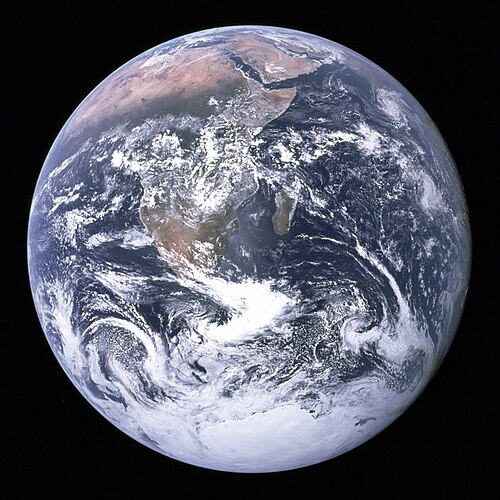 EarthOur home seen as a planet: liquid water, a shielding atmosphere and one large Moon.
 MarsThe cold red desert world with the tallest volcano in the Solar System.
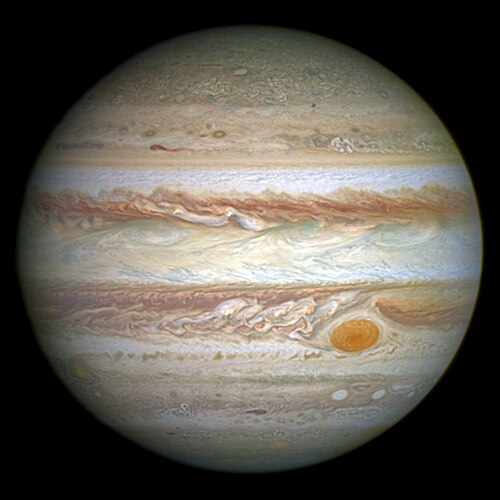 JupiterThe giant striped planet with a centuries-old storm and four big moons.
