Earth

Key facts
| Average distance from the Sun | about 93 million miles (1 AU) |
|---|---|
| Diameter | about 7,926 miles at the equator |
| Mass | 1 Earth mass, the yardstick used to weigh the other planets |
| Length of day | 24 hours (one spin relative to the stars: about 23.9 h) |
| Length of year | about 365.25 days |
| Moons | 1 (the Moon) |
| Surface gravity | 32.2 ft/s² (the reference value, 1 g) |
| Temperature range | about −129 °F to 134 °F (record low and high) |
| Atmosphere main gases | about 78% nitrogen, 21% oxygen, 1% argon |
In short
- Earth is the only world we know of with liquid water on its surface and life.
- Its atmosphere and magnetic field work together to keep the surface mild and shielded.
- The Moon raises tides and helps keep Earth's tilt steady over long periods.
- Seasons come from Earth's 23.4° tilt, not from changes in its distance to the Sun.
- Dozens of satellites watch Earth every day, tracking weather, ice, oceans and land.
A planet like no other we know
Earth is the third planet from the Sun and the largest of the four rocky planets. Seen from far away, it is a small blue and white ball, but up close it is the only place in the universe where we have confirmed life.
Thinking of Earth as one planet among eight helps explain what makes it special. Many of its features exist elsewhere in some form. What is rare is how they combine here.
Earth is also the densest planet in the Solar System. Its heavy iron core, rocky mantle and thin crust were sorted into layers early in its history, while the young planet was still hot enough to be partly molten.
Why Earth can support life
Earth orbits at a distance where sunlight is strong enough to keep water liquid but not so strong that it boils away. Astronomers call this band around a star the habitable zone, meaning the range of distances where surface water could stay liquid.
About 71 percent of the surface is covered by oceans. Water stores heat, moves it around the globe and dissolves the chemicals that living things need.
Those oceans hold about 97 percent of all Earth's water and average about 2.3 miles deep. Most of the rest is locked in ice caps and glaciers, with only a small share in rivers, lakes and the air. Sunlight, which takes about 8 minutes to reach us, drives the cycle that moves this water between sea, sky and land.
Earth is also geologically active. Plate tectonics, the slow movement of huge slabs of crust, recycles carbon between rocks, oceans and air. Over millions of years this works like a thermostat that keeps the climate from drifting too far toward frozen or overheated.
Life itself has changed the planet. Tiny ocean organisms began releasing oxygen through photosynthesis more than 2 billion years ago, slowly filling the air with the gas that most animals now breathe.
Layers of air and an invisible shield
The atmosphere is mostly nitrogen and oxygen, with small amounts of argon, carbon dioxide and water vapor. Its lowest layer, the troposphere, reaches about 5 to 9 miles up and holds nearly all our weather.
Above it is the stratosphere, home to the ozone layer, which absorbs much of the Sun's harmful ultraviolet light. Higher still come the mesosphere, where most meteors burn up, then the thermosphere and the thin exosphere that fades into space.
Deep inside, Earth's liquid iron outer core churns and generates a magnetic field. This field deflects most of the solar wind, a stream of charged particles from the Sun. When some of those particles slip in near the poles, they light up the sky as auroras.
The atmosphere also acts like a blanket. Gases such as carbon dioxide and water vapor trap some of the heat the ground gives off. Without this natural greenhouse effect, Earth's average temperature would sit near 0 °F instead of a comfortable 59 °F.
The Moon's quiet work
Our Moon is unusually large compared with its planet, about one quarter of Earth's width. Its gravity pulls on the oceans, creating two bulges of water that we experience as high and low tides, roughly twice a day.
The Moon also steadies Earth's tilt. Without it, the angle of Earth's axis could swing much more over millions of years, which would bring sharper climate changes. The Moon is slowly moving away, by about 1.5 inches per year, so this partnership changes very gradually.
The Moon also slows Earth's spin a tiny bit through tidal friction. Hundreds of millions of years ago, a day lasted only about 21 or 22 hours.
The Moon sits about 238,855 miles away on average. That gap is so wide that all the other planets in the Solar System could fit side by side inside it. Even so, the Moon's pull is strong enough to leave a visible mark on our coastlines every day.
Seasons come from the tilt
Earth's axis is tilted by about 23.4 degrees. As Earth travels around the Sun, first one hemisphere and then the other leans toward the Sun, getting longer days and more direct sunlight. That is summer; leaning away brings winter.
A common belief is that seasons happen because Earth gets closer to or farther from the Sun. The distance does change a little, but Earth is actually closest to the Sun in early January, during the northern winter.
Near the equator, the Sun stays high all year, so seasons there are mild and often defined by rain rather than temperature. Near the poles, the tilt produces months of daylight in summer and months of darkness in winter.
Earth seen from space
On December 24, 1968, the Apollo 8 crew watched Earth rise over the Moon's gray horizon. Astronaut Bill Anders took a photo now known as Earthrise, which showed many people for the first time how small and isolated our planet looks.
In 1990, as Voyager 1 headed out of the Solar System, it turned its camera back from about 3.7 billion miles away. In that image, Earth is a single faint dot, less than one pixel wide. Carl Sagan called it the Pale Blue Dot and used it to reflect on how much we share that tiny speck.
Astronauts on the International Space Station, about 250 miles up, see Earth's thin atmosphere as a narrow glowing line along the horizon. Many describe that sight as a reminder of how delicate our shield of air really is.
Studying our planet from orbit
Today NASA, ESA and other agencies run fleets of Earth observation satellites. Some, like the Landsat series, have photographed land surfaces since 1972, which lets scientists compare forests, cities and coastlines over decades.
Other satellites measure sea level, ocean temperature, ice sheet thickness, rainfall and the gases in the air. Weather satellites send images every few minutes, which is why forecasts can track storms as they form.
This view from above turns Earth into a planet we can study like any other, with one big difference: we live here, and the measurements help us look after it.
 MarsThe cold red desert world with the tallest volcano in the Solar System.
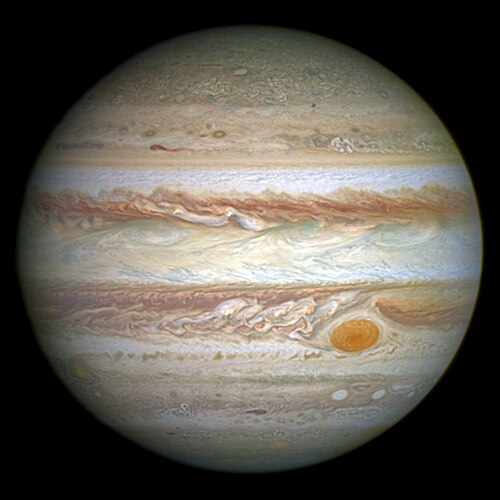 JupiterThe giant striped planet with a centuries-old storm and four big moons.
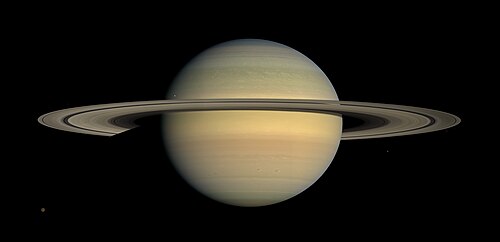 SaturnThe ringed giant, light enough to float, with moons that hide oceans and lakes.
