Mars

Key facts
| Average distance from the Sun | about 141.5 million miles (1.52 AU) |
|---|---|
| Diameter | about 4,212 miles, about half of Earth's |
| Mass | about one tenth of Earth's (0.107 Earth masses) |
| Length of day | about 24 h 40 min (one solar day, called a sol) |
| Length of year | about 687 Earth days |
| Moons | 2 (Phobos and Deimos) |
| Surface gravity | about 38% of Earth's; a 100 lb person would weigh about 38 lb |
| Temperature range | about −199 °F to 80 °F |
| Atmosphere main gases | about 95% carbon dioxide, with some nitrogen and argon |
In short
- Mars is a cold, dry desert with a day only slightly longer than ours.
- It has the Solar System's tallest volcano, Olympus Mons, and a canyon system as long as the United States is wide.
- Dry riverbeds, lake deposits and buried ice show Mars was once much wetter.
- Its air is thin and mostly carbon dioxide, and dust storms can wrap the whole planet.
- Mars comes closest to Earth about every 26 months, when it shines bright orange-red.
The red planet
Mars is the fourth planet from the Sun and the outermost of the rocky planets. It is about half as wide as Earth, and its surface gravity is a little over a third of ours.
Its rusty color comes from iron minerals in the dust and rock that have oxidized, the same chemistry that turns old iron red. Fine dust carried by the wind spreads this color over almost everything, and even tints the sky a pale butterscotch.
Mars has seasons like Earth because its axis is tilted by about 25 degrees, close to our own 23.4. Each season lasts roughly twice as long, since a Martian year is nearly two Earth years.
Giant volcanoes and a huge canyon
Olympus Mons is the tallest volcano known in the Solar System. It rises about 16 miles above the surrounding plains, nearly three times the height of Mount Everest, and its base would cover a state the size of Arizona.
It could grow so large because Mars has no moving tectonic plates. A hot spot below stayed under the same patch of crust for a very long time, piling lava higher and higher.
Valles Marineris is a system of canyons about 2,500 miles long and about 3 to 6 miles deep. It formed mainly as the crust stretched and cracked, not from a river carving it out. On Earth it would stretch from coast to coast across North America.
A planet that was once wet
Orbiters and rovers have found dried riverbeds, deltas and minerals that only form in water. Billions of years ago, Mars likely had lakes and possibly a shallow sea in its northern lowlands.
Today liquid water cannot last long on the surface, because the air is too thin and cold. Water still exists as ice in the polar caps and buried just under the ground across large areas. Finding out whether life ever existed while Mars was wet is one of the main goals of its exploration.
Mars probably lost its thicker early atmosphere because its magnetic field faded long ago. Without that shield, the solar wind slowly stripped gas away into space, a process NASA's MAVEN orbiter has measured directly.
Thin air and dust storms
The Martian atmosphere is about 95 percent carbon dioxide. It is also very thin: the pressure at the surface is less than 1 percent of what we have at sea level on Earth.
Such thin air holds little heat, so temperatures swing widely. A summer afternoon near the equator can reach about 80 °F, while polar nights drop to about −199 °F.
Wind lifts the fine dust into storms. Most are local, but every few years a storm can grow until it covers the whole planet for weeks. A global storm in 2018 blocked so much sunlight that the solar-powered Opportunity rover lost power and fell silent.
The polar caps change with the seasons. In each hemisphere's winter, part of the carbon dioxide in the air freezes onto the cap as dry ice, then turns back into gas in spring. This shifts the planet's air pressure noticeably over the year.
Averaged over the whole planet, the surface sits near −64 °F. Everyday winds are gentle, but gusts can top about 60 mph. Because the air is so thin, even a strong gust would feel like a light breeze to a person standing there.
Phobos and Deimos
Mars has two small, lumpy moons. Phobos is about 14 miles across and Deimos about 8 miles. Both may be captured asteroids, or pieces thrown off by a large impact on Mars long ago.
Phobos orbits so close that it circles Mars three times a day. It is slowly spiraling inward, and in tens of millions of years it will either crash into Mars or break apart into a ring.
Seen from the Martian surface, Phobos rises in the west and sets in the east, because it orbits faster than Mars spins. Deimos, farther out, drifts slowly across the sky over more than two days.
Exploring Mars
Mars is the most visited planet after Earth. NASA's first rover, Sojourner, landed in 1997. The twin rovers Spirit and Opportunity followed in 2004, and Opportunity kept driving for about 14 years.
Curiosity, a car-sized rover, landed in Gale Crater in 2012 and is still studying layered rocks that record the planet's watery past. Perseverance landed in Jezero Crater, an old lake bed, in 2021. It is collecting rock samples that a future mission may bring back to Earth.
Perseverance carried Ingenuity, a small helicopter that made the first powered flight on another planet in April 2021. It was planned for five flights but made 72 before a damaged rotor ended its mission in January 2024. China's Zhurong rover also landed in 2021, and many orbiters from several countries map the planet from above.
Landing is hard. The thin air is enough to heat a spacecraft on the way down but not enough to slow it with parachutes alone, so missions also use rockets, airbags or, for Curiosity and Perseverance, a hovering sky crane that lowered the rover on cables.
How to see Mars yourself
Mars is easy to spot with the naked eye because of its steady orange-red color. It looks best around opposition, when Earth passes between Mars and the Sun. This happens about every 26 months, and Mars then rises at sunset and stays up all night.
Because Mars's orbit is noticeably oval, some oppositions bring it much closer than others, so its brightness and size vary from one to the next.
Through a small telescope near opposition, Mars shows a tiny disk. On steady nights you can often make out a bright white polar cap and darker gray patches, which are areas of exposed rock with less bright dust on top. Higher magnification and patience help, since our own air makes the image shimmer.
Between oppositions, Mars fades and shrinks as Earth pulls ahead in its faster orbit. For a few months around opposition it also appears to move backward against the stars for a while, an effect called retrograde motion that comes from Earth overtaking it.
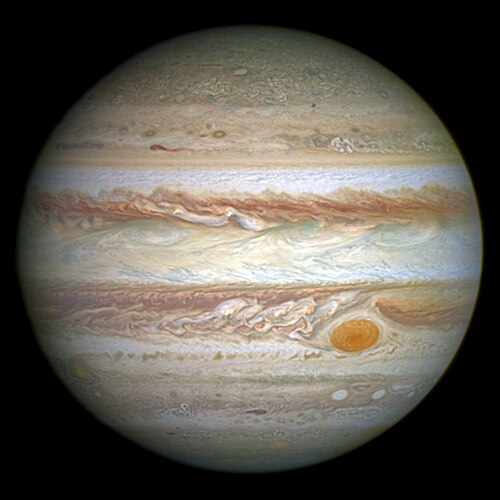 JupiterThe giant striped planet with a centuries-old storm and four big moons.
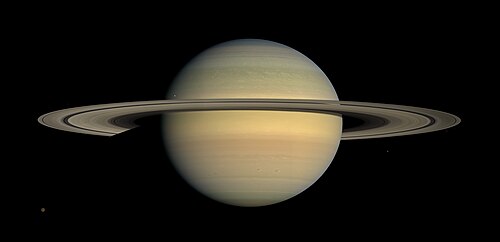 SaturnThe ringed giant, light enough to float, with moons that hide oceans and lakes.
 UranusThe tilted ice giant that rolls around the Sun on its side.
