Jupiter

Key facts
| Average distance from the Sun | about 484 million miles (5.2 AU) |
|---|---|
| Diameter (equatorial) | about 88,850 miles (11 times Earth) |
| Mass | about 318 times Earth |
| Length of day | about 9 hours 56 minutes |
| Length of year | about 11.9 Earth years |
| Moons | 101 known (as of 2026) |
| Gravity at cloud tops | about 2.4 times Earth |
| Cloud-top temperature | about -162°F |
| Main gases | hydrogen (about 90%) and helium (about 10%) |
In short
- Jupiter is the largest planet: more than 1,300 Earths could fit inside it.
- It has no solid surface; what we see are cloud tops of a deep hydrogen and helium atmosphere.
- The Great Red Spot is a storm wider than Earth, but it has been shrinking for over a century.
- Its four largest moons include volcanic Io and Europa, which likely hides an ocean under its ice.
- Even ordinary binoculars show the four big moons as tiny points of light beside the planet.
A world made mostly of gas
Jupiter is the fifth planet from the Sun and by far the biggest. Its mass is more than twice that of all the other planets combined, yet it is made mostly of the two lightest elements, hydrogen and helium.
There is no ground to stand on. If you sank into Jupiter, the gas would slowly get thicker, hotter and more crushed until it behaved like a liquid. Scientists call it a gas giant for this reason.
Jupiter also spins faster than any other planet. A full day lasts just under 10 hours, and that quick rotation makes the planet bulge slightly at its equator.
Bands, zones and the Great Red Spot
Jupiter's stripes come from winds that blow east and west at different speeds in alternating lanes. The pale stripes are called zones, where gas tends to rise and form high, bright ammonia clouds. The darker stripes are called belts, where gas sinks and we see deeper, warmer layers.
The most famous feature is the Great Red Spot, a giant high-pressure storm south of the equator. People have watched it continuously since the 1800s, and it may be older still.
The storm is getting smaller. In the late 1800s it was about 25,500 miles long, wide enough to hold three Earths side by side. Hubble now measures it at about 8,700 miles across, barely the width of one Earth, and it has become rounder. Oddly, it seems to be growing taller and deeper in color as it shrinks. Scientists are still working out why it is shrinking and how long it will last.
Inside Jupiter
Deep inside, the pressure becomes so great that hydrogen is squeezed into a state called metallic hydrogen. In this form it conducts electricity, a bit like a metal wire.
At the center there may be a core of heavier material. Measurements from NASA's Juno spacecraft suggest the core is not a neat, compact ball but a large, fuzzy region where heavy elements mix gradually into the hydrogen around it.
Jupiter also gives off a little more heat than it receives from the Sun. Much of that is leftover warmth from when the planet formed about 4.5 billion years ago.
A huge magnetic bubble
The swirling metallic hydrogen produces a magnetic field about 20 times stronger than Earth's at the cloud tops. This field carves out a magnetosphere, a region of space controlled by the planet's magnetism.
Jupiter's magnetosphere is the largest structure belonging to any planet. If we could see it from Earth, it would look bigger in the sky than the full Moon.
It traps charged particles in intense radiation belts, which are dangerous for spacecraft electronics. It also powers bright auroras, the northern and southern lights, near Jupiter's poles.
The Galilean moons
Jupiter has 101 known moons as of 2026, most of them small and only a few miles across. The four largest were found by Galileo Galilei in 1610 and are named after him.
Io is the most volcanically active body known. Tidal squeezing from Jupiter heats its interior, feeding hundreds of volcanoes that keep repainting its yellow and orange surface.
Europa is covered in a shell of ice. Beneath it there is very likely a global saltwater ocean holding more water than all of Earth's oceans, which makes it one of the best places to search for conditions suitable for life.
Ganymede is the largest moon in the Solar System, bigger than the planet Mercury, and it is the only moon known to have its own magnetic field. Callisto is dark and heavily cratered, with one of the oldest surfaces we know of.
Missions to Jupiter
Pioneer 10 and 11 made the first flybys in 1973 and 1974. Voyager 1 and 2 followed in 1979, revealing Io's volcanoes and a thin, faint ring system around the planet.
The Galileo spacecraft orbited Jupiter from 1995 to 2003 and dropped a probe into its atmosphere. Juno began orbiting in 2016, swinging low over the poles to study the interior, magnetic field and auroras.
Two new missions are on the way. ESA's JUICE launched in April 2023 and should reach Jupiter in July 2031 to study Ganymede, Callisto and Europa. NASA's Europa Clipper launched in 2024 and is due to arrive in 2030 to make dozens of close passes over Europa.
How to see Jupiter
Jupiter is one of the brightest objects in the night sky, usually outshone only by the Moon and Venus. It shines with a steady, cream-colored light and does not twinkle much.
The best time to look is around opposition, when Earth passes between Jupiter and the Sun. The planet is then closest and brightest, rises at sunset and stays up all night. Oppositions happen about every 13 months.
Hold a pair of binoculars steady, ideally braced against something, and you can spot the Galilean moons as small dots in a line beside the planet. Their positions change from night to night.
A small telescope at around 50x or more shows the two main dark belts. On steady nights, with patience, you may also catch the Great Red Spot or a moon's shadow crossing the cloud tops.
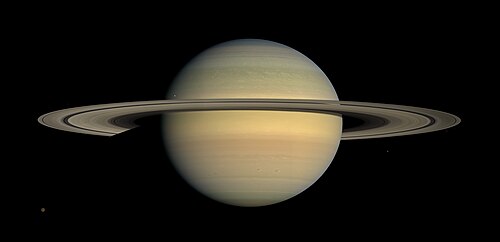 SaturnThe ringed giant, light enough to float, with moons that hide oceans and lakes.
 UranusThe tilted ice giant that rolls around the Sun on its side.
 NeptuneThe windy blue ice giant found with mathematics before anyone saw it.
