Neptune

Key facts
| Average distance from the Sun | About 2.8 billion miles (30.1 AU) |
|---|---|
| Diameter | About 30,600 miles (3.9 times Earth) |
| Mass | About 17 Earths |
| Length of day | About 16 hours 6 minutes |
| Length of year | About 164 Earth years |
| Moons | 16 known (as of 2026) |
| Gravity | About 1.1 times Earth's |
| Cloud-top temperature | About -330°F |
| Main gases | Hydrogen, helium, methane |
In short
- Neptune is the farthest planet from the Sun, about 30 times Earth's distance.
- It was found in 1846 after mathematicians predicted where it should be.
- Its winds reach about 1,200 mph, the fastest measured on any planet.
- Its largest moon, Triton, orbits backward and has geysers of nitrogen gas.
- Voyager 2 is the only spacecraft to visit, flying past in August 1989.
The outermost planet
Neptune is the eighth and most distant planet from the Sun, orbiting about 2.8 billion miles away. Sunlight takes roughly four hours to reach it, and one trip around the Sun lasts about 164 Earth years.
Like Uranus, Neptune is an ice giant. Most of its mass is a hot, dense fluid of water, ammonia and methane around a rocky core, under a thick atmosphere of hydrogen and helium.
It is slightly smaller than Uranus but heavier, at about 17 times Earth's mass. Its deep blue color comes from methane, which absorbs red light, along with haze layers that are thinner than those on Uranus.
Neptune gives off more than twice as much heat as it receives from the Sun. That inner warmth helps power its restless weather, even though its cloud tops sit at about -330°F.
A Neptunian year is so long that the planet has completed only one full orbit since its discovery in 1846. It finished that first lap in 2011.
Found with a pencil before a telescope
After Uranus was discovered, astronomers noticed it was not moving quite as predicted. Something unseen seemed to be tugging on it.
In 1846 the French mathematician Urbain Le Verrier calculated where an unknown planet would have to be to cause those tugs. He sent his prediction to Johann Galle at the Berlin Observatory, who found Neptune on the night of September 23, 1846, within about one degree of the predicted spot. In England, John Couch Adams had made similar calculations, though they were not followed up in time.
It was the first planet found by mathematical prediction rather than by chance, and it became a famous confirmation of Newton's law of gravity. The name comes from the Roman god of the sea.
The windiest place we know
Neptune has the strongest winds measured on any planet. Near the equator they blow at around 1,200 mph, faster than the speed of sound on Earth.
When Voyager 2 flew past in 1989, it photographed a huge storm called the Great Dark Spot, about as wide as Earth, with bright white clouds of methane ice nearby. When the Hubble Space Telescope looked a few years later, that spot had vanished.
Since then, Hubble has watched several new dark spots appear and fade. These storms seem to last only a few years, unlike Jupiter's Great Red Spot, which has persisted for centuries.
Why such a distant, cold planet has such powerful winds is not fully understood. One possible explanation is that Neptune's atmosphere has very little friction to slow the wind, so once currents speed up they can keep their energy for a long time. The planet's inner heat keeps feeding the motion.
Triton and the other moons
As of 2026, Neptune has 16 known moons. The two most recent, both only a few miles across, were announced in 2024 after observations with large ground-based telescopes.
Triton is by far the largest, about 1,680 miles wide. It orbits in the opposite direction to Neptune's spin, which is called a retrograde orbit. No other large moon in the Solar System does this, and it strongly suggests Triton formed elsewhere, probably in the Kuiper Belt (the icy zone beyond Neptune), and was captured by Neptune's gravity.
Triton is one of the coldest surfaces ever measured, at about -390°F. Even so, Voyager 2 saw dark plumes rising several miles above it. These geysers are thought to be nitrogen gas warmed slightly by sunlight under a layer of ice.
Because of its backward orbit, Triton is slowly spiraling inward. In billions of years it may be torn apart and form a new ring around the planet.
Rings with clumps
Neptune has five main rings, named after astronomers linked to its discovery: Galle, Le Verrier, Lassell, Arago and Adams. They are faint and dark, made of dust and ice coated with darker material.
The outer Adams ring holds a puzzle. Instead of being evenly spread, part of it is bunched into bright segments called arcs. Astronomers think the gravity of a small nearby moon, Galatea, helps keep these clumps from smoothing out. Webb telescope images in 2022 showed the rings more clearly than at any time since Voyager.
Visits and future plans
Voyager 2 remains the only spacecraft to visit Neptune. It passed about 3,000 miles above the north pole on August 25, 1989, then flew about 25,000 miles from Triton five hours later, its last planetary encounter before heading out toward interstellar space.
Today Neptune is studied with Hubble, Webb and large telescopes on Earth. Scientists have proposed missions to orbit Neptune and visit Triton, but as of 2026 none has been approved or scheduled.
Reaching Neptune is one of the hardest trips in the Solar System. With today's rockets, a spacecraft could take 12 to 15 years to arrive, so launch windows are planned around years when Jupiter's gravity can be used to speed the craft up.
How to see Neptune yourself
Neptune is never visible to the naked eye. At its brightest it is about five times too faint to see without help, so you will need binoculars or a telescope.
The hardest part is knowing where to look. Use a planetarium app or a detailed star chart showing Neptune's position for the current month, then match the pattern of faint stars in your binoculars to the chart. Neptune is the dot that is not printed on a normal star map.
In binoculars it looks like an ordinary faint star. A telescope at high magnification shows a tiny blue disk, with no visible detail. If you check again a few nights later, you can confirm your find by seeing that it has moved slightly against the stars.
Like Uranus, Neptune is best seen around opposition, when it is up all night. In recent years it has been in the autumn evening sky.
 MercuryThe smallest planet, closest to the Sun, with scorching days and frozen nights.
 VenusEarth's cloud-wrapped twin in size, and the hottest planet in the Solar System.
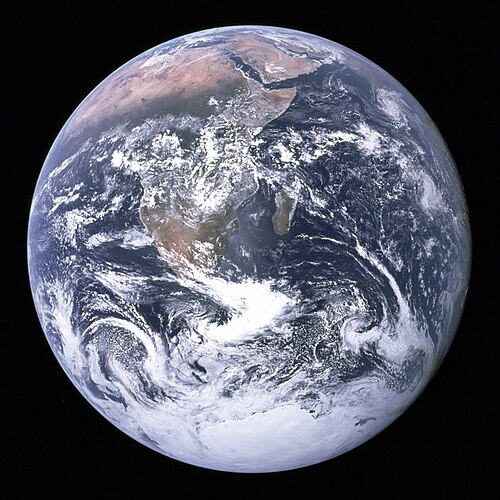 EarthOur home seen as a planet: liquid water, a shielding atmosphere and one large Moon.
