Mercury
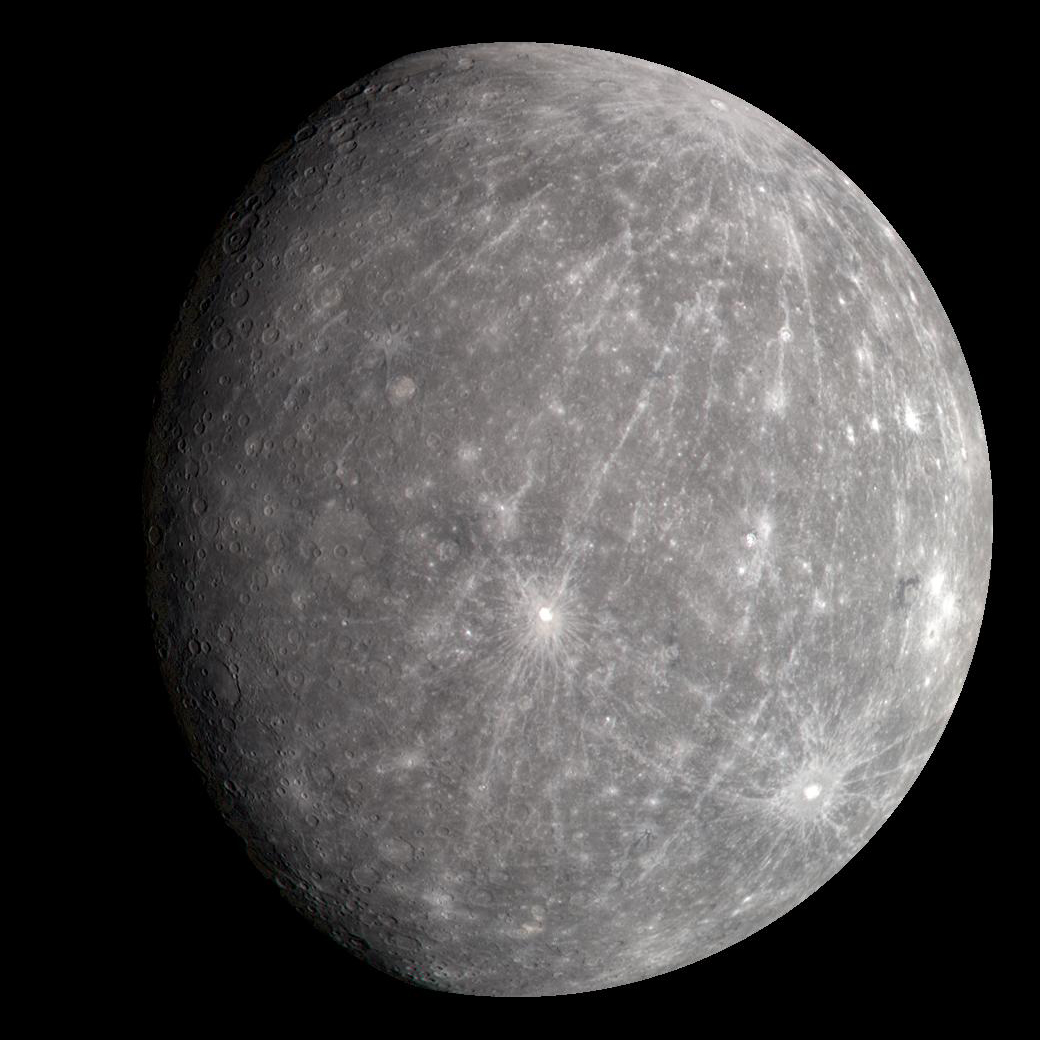
Key facts
| Average distance from the Sun | about 36 million miles (0.39 AU) |
|---|---|
| Diameter | about 3,032 miles |
| Mass | about 0.055 × Earth |
| Length of day (one spin) | about 58.6 Earth days |
| Sunrise to sunrise | about 176 Earth days |
| Length of year | about 88 Earth days |
| Moons | 0 |
| Surface gravity | about 0.38 × Earth |
| Surface temperature | about −290 °F at night to 800 °F by day |
In short
- Mercury is the smallest planet and the one closest to the Sun.
- It has almost no air, so its surface swings from about 800 °F by day to about −290 °F at night.
- Its metal core fills most of the planet's interior, far more than Earth's does.
- One sunrise to the next takes about 176 Earth days, two full Mercury years.
- You can see it with the naked eye, low in twilight, a few weeks a year.
What Mercury is like
Mercury is a small, rocky world only a little larger than our Moon. It circles the Sun faster than any other planet, which is how it earned the name of the quick-footed Roman messenger god.
Seen up close, it looks a lot like the Moon: gray, dusty and covered in craters. There are no oceans, no clouds and no moons. A person who weighs 100 lb on Earth would weigh about 38 lb there.
Surface and a very thin 'air'
Mercury has no real atmosphere. Instead it has an exosphere, a sparse scattering of atoms such as sodium, potassium and oxygen that are knocked off the surface by sunlight and the solar wind (the stream of charged particles flowing out from the Sun). There is far too little of it to trap heat or to breathe.
Without a blanket of air, heat escapes as soon as the Sun sets. That is why Mercury is not the hottest planet even though it is the closest. Daytime ground can reach about 800 °F, hot enough to melt lead, while the night side drops to about −290 °F.
The surface records billions of years of impacts. The largest scar, the Caloris Basin, is roughly 960 miles across. Long cliffs, some more than a mile high, wind across the plains. Scientists think they formed as the planet cooled and shrank, wrinkling its crust like the skin of a drying apple.
Inside Mercury
For its size, Mercury is unusually heavy. Its iron-rich core stretches out to about 85 percent of the planet's radius, leaving only a thin rocky mantle and crust on top. On Earth, the core reaches only about half way out.
Part of that core is still molten, and its slow churning produces a weak magnetic field, about 1 percent as strong as Earth's. Why Mercury has so much metal is still debated. One idea is that a giant collision early in its history stripped away much of its outer rock.
A strange calendar
Mercury spins once every 58.6 Earth days and orbits the Sun every 88 days. These two motions lock together in a 3 to 2 pattern: three spins for every two trips around the Sun.
The result is a very long solar day. From one sunrise to the next takes about 176 Earth days, so a single Mercury 'day' lasts two of its years. Its orbit is also the most stretched of all the planets, ranging from about 29 million to 43 million miles from the Sun.
Mercury's axis is almost perfectly upright, so it has no real seasons. Deep craters near its poles never see sunlight, and they stay cold enough to hold ice.
Exploring Mercury
Mercury is hard to reach. A spacecraft falling toward the Sun picks up so much speed that it needs years of looping flybys to slow down enough to stay in orbit.
NASA's Mariner 10 made the first visits, flying past three times in 1974 and 1975 and photographing a little under half the surface. NASA's MESSENGER flew past three times and then orbited Mercury from 2011 to 2015. It mapped the whole planet, found strong evidence for water ice in the polar craters and was steered into the surface at the end of its mission.
BepiColombo, a joint mission of ESA and Japan's space agency JAXA, launched in 2018. As of autumn 2026, its arrival in orbit is planned for November 2026, followed by a split into two orbiters and a main science phase expected to begin in 2027.
How to see Mercury in the sky
Mercury never strays far from the Sun in our sky, so you only see it low near the horizon in twilight. Look in the west shortly after sunset or in the east shortly before sunrise.
The best chances come near greatest elongation, the times when Mercury appears farthest from the Sun, up to about 28 degrees away. Each one lasts a week or two and they happen several times a year. A flat, clear horizon helps a lot, and the planet looks like a bright, steady, slightly pinkish star.
Through a small telescope Mercury shows phases like a tiny Moon, but little surface detail. Never point binoculars or a telescope near the Sun: wait until the Sun has fully set, or has not yet risen, because even a brief glimpse of sunlight through optics can cause permanent eye damage.
Did you know?
Every so often Mercury passes directly between Earth and the Sun and appears as a small black dot crossing the solar disk. This is called a transit. The next one will happen on 13 November 2032, and it should only be watched with proper solar filters.
 VenusEarth's cloud-wrapped twin in size, and the hottest planet in the Solar System.
 EarthOur home seen as a planet: liquid water, a shielding atmosphere and one large Moon.
 MarsThe cold red desert world with the tallest volcano in the Solar System.
