Gemini

Key facts
| IAU abbreviation | Gem |
|---|---|
| Size | 30th largest of the 88 constellations |
| Brightest star | Pollux (Beta Gem), magnitude about 1.15, about 34 light-years away |
| Best evening season (about 40°N) | January to March, high in the south |
| Visible latitudes | Between about +90° and −60° |
| Notable deep-sky objects | M35, NGC 2158, NGC 2392 (Eskimo Nebula) |
| Meteor shower | Geminids, peaking around December 13–14 |
| Mythology origin | Babylonian twin gods; Greek Castor and Pollux |
| Equipment needed | Eyes; binoculars for M35, a telescope for the Eskimo Nebula |
In short
- Gemini's two bright stars, Castor and Pollux, mark the twins' heads and are easy to spot together.
- Pollux is the brighter of the two, even though Castor has the Alpha label.
- Castor is a system of six stars bound together, though it looks like one point to the eye.
- The open cluster M35 is a fine binocular target at the twins' feet.
- The Geminids in December are one of the richest meteor showers of the year.
Two bright stars side by side
Gemini, the Twins, is a zodiac constellation of the winter and early spring sky. Its outline is two parallel lines of stars, like two stick figures standing side by side and holding hands, with their feet near Orion and their heads to the northeast.
The Sun passes in front of Gemini from about late June to late July. Planets and the Moon often move through it, which can make a familiar pattern look different for a while.
Gemini also has a place in the history of astronomy. William Herschel discovered Uranus here in 1781, and Clyde Tombaugh found Pluto in 1930 on photographs of this region.
From about 40°N, Gemini climbs nearly overhead on January and February evenings, well above most haze and city glow.
How to find it
Start at Orion. Draw a line from Rigel, at Orion's lower right, through Betelgeuse, at the upper left, and continue about the same distance again. You arrive near Castor and Pollux, two bright stars about 4.5 degrees apart, roughly the width of three fingers.
A second route uses the Big Dipper. Draw a line from Megrez, where the handle joins the bowl, diagonally across the bowl through Merak, its lower front star, and extend it far to the southwest. It ends close to the twins.
From the two heads, follow two fainter lines of stars down toward Orion. They end at Alhena, in Pollux's foot, and at Tejat and Propus, in Castor's foot.
The main stars and their names
Pollux (Beta Geminorum), magnitude about 1.15, is an orange giant about 34 light-years away, making it the nearest giant star to the Sun. A planet larger than Jupiter has been found orbiting it.
Castor (Alpha Geminorum), magnitude about 1.6 combined, is about 51 light-years away. A small telescope splits it into two white stars, and a faint red star nearby belongs to the same family. Each of these three is itself a close pair, so Castor is really six stars.
Alhena (Gamma Geminorum), magnitude about 1.9, has an Arabic name often explained as 'the brand' or mark on a camel's neck. Mebsuta and Mekbuda, along the twins' bodies, also carry Arabic names, describing parts of an outstretched lion's paw from an older star picture.
Deep-sky objects for binoculars and small telescopes
M35 is an open cluster of a few hundred stars about 2,800 light-years away, near Propus at Castor's feet. On a dark night it is just visible to the naked eye as a hazy spot, and binoculars show it as a rich, grainy patch about the size of the full Moon.
In a small telescope, look at the edge of M35 for NGC 2158, a smaller and much more distant cluster that appears as a faint smudge. Seeing both in one field shows how distance shrinks a cluster.
The Eskimo Nebula (NGC 2392) is a planetary nebula, the gas shell thrown off by a dying Sun-like star. It lies about 2.5 degrees southeast of Wasat (Delta Geminorum). In a small telescope it looks like a fuzzy, bluish star; more magnification shows a round disk.
Mythology
Babylonian astronomers already saw a pair of twins here, linked to two gods who guarded gateways. The idea of two inseparable brothers has stayed with these stars ever since.
In Greek myth, Castor and Pollux (Polydeuces) were twin brothers with the same mother, Leda, but different fathers. Pollux, son of Zeus, was immortal; Castor was mortal. When Castor was killed, Pollux asked to share his immortality, and Zeus placed both in the sky together.
Sailors honored the twins as protectors at sea. In Turkish the constellation is called İkizler.
Practical observing tips
From January to March, Gemini is high in the evening sky. Compare Castor and Pollux side by side: Pollux looks slightly brighter and warmer in color, Castor whiter. This makes a nice first lesson in star colors.
For the Geminids, observe on the nights around December 13 and 14. Under dark skies you may see up to about 120 meteors an hour near the peak, and Gemini is already well up by mid-evening. Unusually, their source is an asteroid, 3200 Phaethon, not a comet.
To see meteors well, look about halfway up the sky, not straight at Gemini. Dress warmly, lie back on a reclining chair and give your eyes time to adapt. No telescope or binoculars are needed.
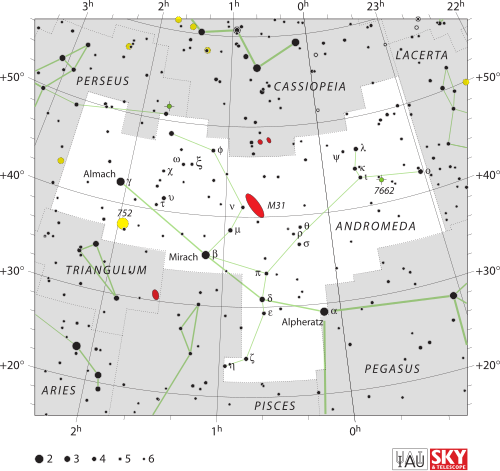 AndromedaThe Chained Princess and the Andromeda Galaxy, the most distant thing your eyes can see.
 Crux, the Southern CrossThe smallest constellation, a bright cross that guides southern observers to the pole.
 OrionThe Hunter of winter evenings, with a famous belt, a red giant and a glowing nebula.
