Andromeda

Key facts
| IAU abbreviation | And |
|---|---|
| Size | 19th largest of the 88 constellations |
| Brightest star | Alpheratz (Alpha And), magnitude about 2.1, about 97 light-years away; Mirach is almost as bright |
| Best evening season (about 40°N) | October to December, nearly overhead |
| Visible latitudes | Between about +90° and −40° |
| Notable deep-sky objects | M31 Andromeda Galaxy, M32, M110, NGC 752, NGC 7662 (Blue Snowball) |
| Famous neighbor | Shares Alpheratz with the Great Square of Pegasus |
| Mythology origin | Greek princess Andromeda, rescued by Perseus |
| Equipment needed | Eyes for M31 under dark skies; binoculars make it much easier |
In short
- Andromeda is a chain of stars running northeast from one corner of the Great Square of Pegasus.
- Its main attraction is the Andromeda Galaxy, M31, about 2.5 million light-years away.
- M31 is the most distant object most people can see with the naked eye.
- The double star Almach shows a lovely gold and blue color contrast in a small telescope.
- From 40°N Andromeda passes almost overhead on autumn evenings.
A princess and a galaxy
Andromeda is a large constellation of the autumn sky. It is not part of the zodiac and its stars are only moderately bright, so on its own it would be easy to overlook.
What makes it famous is a faint oval glow within its borders: the Andromeda Galaxy, a spiral galaxy like our own Milky Way. Its light has traveled about 2.5 million years to reach us, so when you see it, you are looking at light that left before modern humans existed.
From mid-northern latitudes, Andromeda is circumpolar for part of its length, meaning its northern stars stay above the horizon all night for much of the year.
How to find it
Start with the Great Square of Pegasus, four stars forming a large square high in the south and east on autumn evenings. Each side is about 15 degrees, a fist and a half. The top left (northeast) star of the square is Alpheratz, which belongs to Andromeda.
From Alpheratz, a line of stars runs to the northeast: first Delta Andromedae, then Mirach, then Almach. These are spaced roughly a fist apart and form the princess's body.
To find the galaxy, go to Mirach, then move up (northwest) through two fainter stars, Mu and Nu Andromedae. Just beyond Nu, a small elongated haze appears. Another route uses Cassiopeia's W: the deeper V of the W points roughly toward M31.
The main stars and their names
Alpheratz (Alpha Andromedae), magnitude about 2.1 and about 97 light-years away, takes its name from an Arabic phrase about the navel of the horse, from a time when it was seen as part of Pegasus. Today it belongs officially to Andromeda only.
Mirach (Beta Andromedae) is a red giant about 200 light-years away and nearly as bright as Alpheratz. Its name is thought to come from an Arabic word for the waist or loins. It is also a guide star for the galaxy M31 and for the faint galaxy NGC 404, which sits so close to Mirach that it is nicknamed 'Mirach's Ghost'.
Almach (Gamma Andromedae), magnitude about 2.1, marks the princess's foot. Its name comes from an Arabic word for a small desert animal. In a small telescope it splits into a bright golden star and a fainter blue companion, one of the prettiest color pairs in the sky.
Deep-sky objects for binoculars and small telescopes
The Andromeda Galaxy (M31) contains roughly a trillion stars. Under a dark sky it is visible to the naked eye as a soft smudge. Binoculars show a bright core with a long oval halo; in reality the galaxy spans about six times the width of the full Moon, though only the center is easy to see.
Two companion galaxies circle M31. M32 is a small round glow just south of the core, and M110 is a fainter oval to the northwest. A small telescope at low power can show all three in one view.
Elsewhere in Andromeda, NGC 752 is a large, loose open cluster south of Almach that suits binoculars. NGC 7662, the Blue Snowball, is a planetary nebula near the border with Lacerta; a small telescope shows it as a tiny blue-green disk.
Mythology
In Greek myth, Queen Cassiopeia boasted that she or her daughter Andromeda was more beautiful than the sea nymphs. To punish this, Poseidon sent the sea monster Cetus to attack the kingdom. King Cepheus was told to chain Andromeda to a rock by the sea as a sacrifice.
The hero Perseus, flying home after killing Medusa, saw Andromeda, killed the monster and married her. All the main characters are in this part of the sky: Cassiopeia, Cepheus, Perseus, Cetus and Pegasus, the winged horse.
Earlier, the Persian astronomer al-Sufi described the Andromeda Galaxy as a 'little cloud' in his Book of Fixed Stars around 964 CE, the oldest known written record of it. The constellation is called Andromeda in Turkish too, sometimes with the description Zincirli Prenses.
Practical observing tips
From 40°N, Andromeda is best between October and December, from about 8 p.m. to midnight, when it is high overhead and the air is clearest. It also rises in the northeast late on summer nights.
Find a dark site and avoid the Moon. City light easily hides M31, so try averted vision: look a little to the side of where the galaxy should be. Low-power binoculars give the most satisfying view.
Do not expect a spiral like in photographs. The eye cannot collect light over time the way a camera can, so the galaxy looks like a gray oval. A camera on a tripod with a modest lens and a 15 to 30 second exposure will begin to show its shape.
 Crux, the Southern CrossThe smallest constellation, a bright cross that guides southern observers to the pole.
 OrionThe Hunter of winter evenings, with a famous belt, a red giant and a glowing nebula.
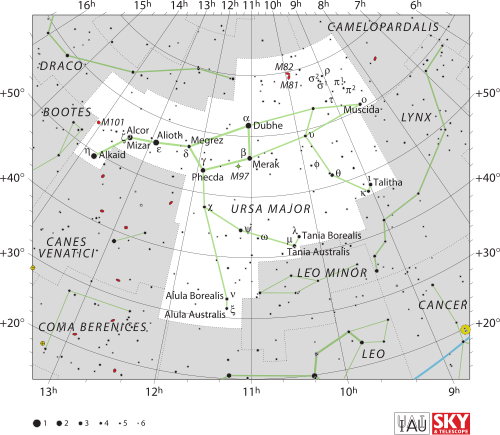 Ursa MajorThe Great Bear and its Big Dipper, the northern sky's most useful signpost.
