Orion

Key facts
| IAU abbreviation | Ori |
|---|---|
| Size | 26th largest of the 88 constellations |
| Brightest star | Rigel, magnitude about 0.1, roughly 860 light-years away |
| Second brightest | Betelgeuse, varies about 0.0 to 1.6, roughly 550 light-years (estimates vary) |
| Best evening season at 40°N | December to March, highest in January |
| Visible from | Latitudes about 85°N to 75°S |
| Deep-sky highlights | Orion Nebula (M42), De Mairan's Nebula (M43), M78 |
| Mythology | Greek hunter Orion; al-Jabbar, 'the giant', in Arabic tradition |
| Equipment needed | None for the stars; binoculars for the nebula |
In short
- Orion is the easiest winter constellation to learn, thanks to three bright stars in a short, straight row: the Belt.
- Its two brightest stars have different colors: blue-white Rigel and orange-red Betelgeuse.
- The Orion Nebula (M42), a star-forming cloud, is visible to the naked eye as a fuzzy 'star' in the Sword.
- The Belt points to Sirius in one direction and to Aldebaran and the Pleiades in the other.
- Orion sits on the celestial equator, so it can be seen from almost every inhabited place on Earth.
The Hunter in the winter sky
On a clear evening between December and March, look south from the northern hemisphere and you will see a large hourglass of bright stars. That is Orion, the Hunter, one of the oldest and most recognized star patterns in any culture.
Four bright stars mark the shoulders and knees, and three in a neat row form his belt. A fainter line hanging below the belt is his sword. Because the constellation straddles the celestial equator, the sky's equivalent of Earth's equator, people in both hemispheres know it, though southern observers see it upside down.
How to find it
Orion needs almost no help: the Belt is the key. Three stars of similar brightness, spaced evenly in a line about 3 degrees long, are hard to mistake for anything else. At 40°N in mid-January, Orion stands about halfway up the southern sky around 9 p.m.
Once you have it, use the Belt as a pointer. Follow it down and to the left (as seen from the north) about 20 degrees and you reach Sirius, the brightest star of the night sky. Follow it up and to the right about the same distance to orange Aldebaran in Taurus, then a bit farther to the Pleiades cluster.
A line from Rigel through Betelgeuse continues toward Gemini's twin stars, Castor and Pollux. Orion is the center of the Winter Hexagon, a ring of six bright stars around it.
Main stars and their names
Most of Orion's star names come from Arabic. Betelgeuse is usually traced to yad al-jawza, 'hand of al-Jawza', an old name for the giant figure. It is a red supergiant so large that, placed where the Sun is, it would reach beyond the orbit of Mars. Its brightness changes slowly, and in 2019–2020 it dimmed noticeably for months.
Rigel, from rijl, 'foot', marks the Hunter's left foot. It is a blue-white supergiant tens of thousands of times more luminous than the Sun. Bellatrix, Latin for 'female warrior', is the other shoulder, and Saiph, 'sword', the other knee.
The Belt stars are Alnitak ('the girdle'), Alnilam ('string of pearls') and Mintaka ('the belt'). Alnilam, in the middle, is the most distant of the three, at roughly 2,000 light-years by many estimates, a reminder that stars in a pattern are not neighbors in space.
Deep-sky objects for binoculars and small telescopes
The Orion Nebula, M42, is the showpiece. It is a cloud of gas and dust about 1,300 light-years away where new stars are forming right now. To the eye it looks like the fuzzy middle 'star' of the Sword. In binoculars it becomes a soft glowing patch, and a small telescope shows wings of nebula and the Trapezium, four young stars packed together at its heart.
Right next to it, separated by a dark lane, is the smaller M43. North of the Belt, M78 is a faint reflection nebula, a cloud lit by nearby stars; it needs a dark sky and a telescope. Alnitak is also the gateway to the famous Horsehead Nebula, but that is a hard target even for experienced observers.
Sigma Orionis, just below Alnitak, is a pretty multiple star in a small telescope.
Mythology
In Greek myth Orion was a giant hunter, son of the sea god Poseidon in many versions. Stories differ on his death: one says he boasted he would kill every animal on Earth, so Gaia, the Earth, sent a scorpion that stung him. The gods placed both in the sky on opposite sides, so Orion sets as Scorpius rises.
Arabic astronomers called the figure al-Jabbar, 'the giant'. In ancient Egypt the stars were linked with Osiris, god of the afterlife. Many cultures saw the Belt alone: in parts of Anatolia and the Balkans it was seen as a set of scales or three walkers, and in South Africa as three zebras. These local names vary, and they show how the same bright row caught everyone's eye.
Practical observing tips
Go out in January or February, an hour or two after dark, when Orion is high in the south. Give your eyes 20 minutes to adjust and use only a dim red light. Compare the colors of Betelgeuse and Rigel; the difference is clear even from a town.
From a suburb you will see the main seven stars. From a dark site the Sword shows its glow, and you can count many fainter stars in the outline. Steady binoculars, braced on a wall or a tripod, make M42 much easier. In late spring Orion sinks into the evening twilight in the west and returns to the morning sky in late summer.
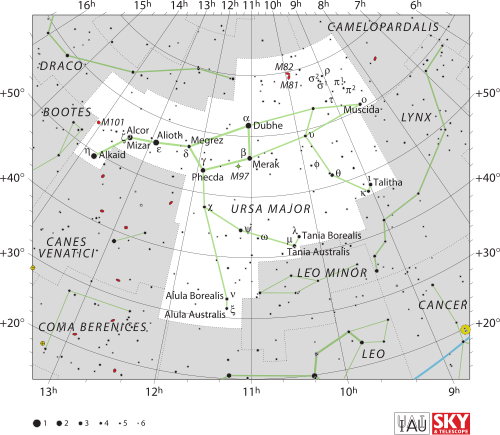 Ursa MajorThe Great Bear and its Big Dipper, the northern sky's most useful signpost.
 CassiopeiaThe Queen's bright W, opposite the Big Dipper, rich in star clusters.
 CygnusThe Swan, or Northern Cross, flying down the summer Milky Way.
