Cygnus
Key facts
| IAU abbreviation | Cyg |
|---|---|
| Size | 16th largest of the 88 constellations |
| Brightest star | Deneb, magnitude about 1.25, roughly 1,500 to 2,600 light-years away (distance uncertain) |
| Famous asterism | The Northern Cross; Deneb is also a corner of the Summer Triangle |
| Best evening season at 40°N | July to October, highest in late August and September |
| Visible from | Latitudes about 90°N to 40°S |
| Deep-sky highlights | Open clusters M39 and M29, North America Nebula (NGC 7000), Veil Nebula, the double star Albireo |
| Mythology | Zeus as a swan; in East Asia, part of the Milky Way river |
| Equipment needed | None for the Cross; binoculars for the Milky Way |
In short
- Cygnus, the Swan, looks like a large cross, so its main stars are often called the Northern Cross.
- Deneb, its brightest star, is one of the most luminous stars visible to the naked eye, and very far away.
- Albireo, the Swan's beak, is a gold and blue double star that a small telescope splits easily.
- Cygnus lies right on the Milky Way, so binoculars show dense star fields and dark dust lanes.
- With Vega and Altair, Deneb forms the Summer Triangle, the main landmark of summer evenings.
The Swan of summer nights
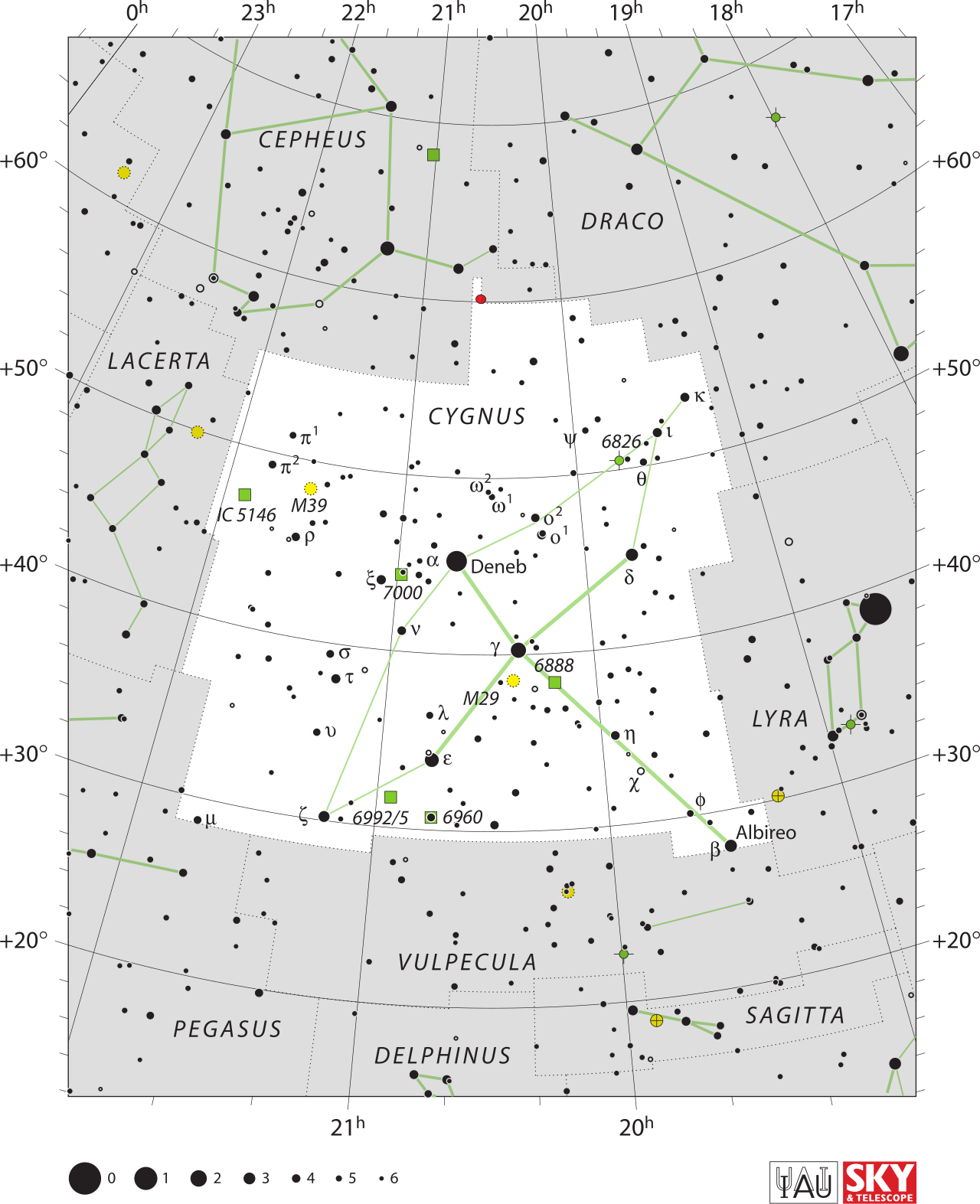
On summer and early autumn evenings, a large cross of stars flies along the Milky Way high overhead. That is Cygnus, the Swan. Its long neck stretches south toward Albireo, its tail is marked by Deneb, and its wings spread to each side.
Because the cross is so clear, many people know the pattern as the Northern Cross, the counterpart of the Southern Cross far to the south. The Milky Way, the glow of billions of distant stars in our galaxy, runs right through it and splits into two streams here, divided by a dark rift of dust.
How to find it
Start with the Summer Triangle, three bright stars high in the east after dark in July and nearly overhead by September. The brightest, Vega, is in Lyra; the one at the southern point is Altair in Aquila; and the one farthest north-east is Deneb, the Swan's tail.
From Deneb, look along the Milky Way toward Altair. The long arm of the cross runs that way, through Sadr in the middle to Albireo, about halfway to Altair. The short arm crosses at Sadr, with Gienah on one wing and Delta Cygni on the other.
From a city the Swan's body is clear but its wing tips fade. From a dark site the whole bird is easy.
Main stars and their names
Deneb comes from the Arabic dhanab, 'tail', and other stars, such as Denebola in Leo, share the root. Deneb is a white supergiant. Its distance is hard to measure, and published values range from about 1,500 to 2,600 light-years. Even at the lower value it shines with tens of thousands of times the Sun's light.
Sadr means 'chest'. Gienah means 'wing', a name that also appears in other constellations. Albireo, the beak, has a confused name that grew from mistranslations of Arabic and Latin in medieval star catalogs.
Albireo is the favorite of many observers. In a small telescope at low power it splits into a golden star and a fainter blue one. Whether the two are truly a pair orbiting each other is still debated, since recent measurements suggest they may lie at different distances.
Deep-sky objects for binoculars and small telescopes
M39, near the tail, is a large, loose open cluster that fits nicely in binoculars. M29, near Sadr, is a small group of a few bright stars sometimes called the Cooling Tower.
Just east of Deneb, a dark sky reveals a faint glow shaped like the North American continent: the North America Nebula, NGC 7000. It is big and dim, so it is easier in binoculars than in a telescope, and a filter that blocks light pollution helps a lot.
The Veil Nebula, south of the wing star Epsilon Cygni, is what remains of a star that exploded thousands of years ago. It needs a telescope, a dark sky and ideally a nebula filter. Without any filter, simply sweeping the Milky Way through Cygnus with binoculars is one of the best views of summer.
Mythology
Greek stories link the Swan to Zeus, who took the form of a swan to visit Leda, queen of Sparta. Other versions name Orpheus, turned into a swan after his death and placed next to his lyre, or Cycnus, a friend of Phaethon who searched the river for him.
In East Asia the Milky Way is a celestial river. In the story celebrated as Qixi in China and Tanabata in Japan, Vega is a weaving girl and Altair a herdsman, kept apart by the river; once a year a bridge of magpies, sometimes linked with Deneb, lets them meet. Arab astronomers saw a flying bird here, like the Greeks.
Practical observing tips
From about 40°N Cygnus is up for much of the year, but late summer evenings are best, when it is close to overhead. A reclining chair makes looking straight up much easier on your neck.
Pick a moonless night and a site away from city lights so the Milky Way shows. Let your eyes adapt for 20 to 30 minutes, then trace the dark Great Rift that runs from Cygnus toward Aquila. For Albireo, any small telescope at low power will do, even under bright skies.
 LyraA small harp with brilliant Vega, a famous double-double and the Ring Nebula.
 ScorpiusThe Scorpion of summer, with red Antares and rich star clusters low in the south.
 SagittariusThe Archer and its Teapot asterism, pointing straight at the heart of the Milky Way.
