Crux, the Southern Cross

Key facts
| IAU abbreviation | Cru |
|---|---|
| Size | 88th, the smallest of all constellations |
| Brightest star | Acrux (Alpha Cru), magnitude about 0.8 combined, about 320 light-years away |
| Best evening season (southern latitudes) | March to June, high in the south |
| Visible latitudes | Between about +25° and −90°; never sets south of about 34°S |
| From the north | Whole cross visible only south of about 25°N (e.g., Hawaii, southern India); not visible from Türkiye or most of Europe |
| Notable deep-sky objects | NGC 4755 Jewel Box, Coalsack Nebula (Caldwell 99) |
| Mythology origin | Named by European navigators in the 1500s; older Aboriginal, Māori and Inca traditions |
| Equipment needed | Eyes; binoculars for the Jewel Box |
In short
- Crux is the smallest of the 88 constellations, but four bright stars make it easy to recognize.
- Its long axis points toward the south celestial pole, the southern counterpart of Polaris's role.
- The two Pointers, Alpha and Beta Centauri, help tell the real cross from the fainter 'False Cross'.
- Next to it lie the Jewel Box star cluster and the dark Coalsack Nebula.
- From about 40°N Crux never rises; you need to travel south of roughly 25°N to see it whole.
The smallest constellation
Crux, the Southern Cross, covers less sky than any other constellation, about 5 percent of the area of Hydra, the largest. Yet four bright stars arranged like a kite or cross make it one of the most recognizable sights of the southern sky.
It sits in a bright stretch of the Milky Way, surrounded by the much larger constellation Centaurus. In ancient Greek times the stars of Crux were counted as part of Centaurus; they became a separate constellation only after European voyages to the southern seas in the 1500s and 1600s.
Crux appears on the national flags of Australia, New Zealand, Brazil, Papua New Guinea and Samoa, a sign of how important it is to people in the south.
Who can see it
Crux lies about 60 degrees south of the celestial equator. From southern Australia, South Africa, Argentina or New Zealand, south of about 34°S, it never sets and can be seen on any clear night of the year. It stands highest on evenings from March to June.
In the northern hemisphere, the whole cross rises above the horizon only south of about 25°N, for example in Hawaii, southern India, the Caribbean or the southern Sahara. Even there it stays low, best seen on April and May evenings. Between about 25°N and 33°N only the upper stars of the cross, starting with Gacrux, peek above the horizon.
From 40°N, including Türkiye, Greece and most of Europe and the US, Crux never rises. Interestingly, about 2,000 years ago a slow wobble of Earth's axis called precession placed it low but visible from the Mediterranean.
How to find it and use it
Look south for two bright stars close together, Alpha and Beta Centauri, called the Pointers. Follow the line from Alpha through Beta and you reach the cross about one fist away. This step helps avoid the False Cross, a larger and fainter cross made by stars of Vela and Carina.
To find the south celestial pole, extend the long bar of the cross from Gacrux through Acrux about four and a half times its length. Then draw a line at right angles from the middle of the Pointers. Where the two lines meet is close to the pole, and straight down from there is due south.
There is no bright 'South Star', so this method has been used for centuries by navigators and travelers.
The main stars and their names
Acrux (Alpha Crucis), at the foot of the cross, has a combined magnitude of about 0.8 and lies about 320 light-years away. Its name is a simple modern blend of 'Alpha' and 'Crux'. A small telescope splits it into two blue-white stars.
Mimosa (Beta Crucis), magnitude about 1.25 and about 280 light-years away, is on the left arm; its name may refer to the mimosa flower or to the Latin for 'actor'. Gacrux (Gamma Crucis), at the top, is a red giant about 88 light-years away, the closest red giant to the Sun, and its orange tint is visible to the eye.
Delta Crucis, magnitude about 2.8, completes the cross. A fainter fifth star, Epsilon Crucis, sits off-center, and it too appears on several flags.
Deep-sky objects for binoculars and small telescopes
The Jewel Box (NGC 4755) is a young open cluster next to Mimosa, about 6,500 light-years away. The English astronomer John Herschel named it in the 1830s for its mix of blue-white and one striking orange-red star. Binoculars show a compact sparkle; a small telescope reveals the colors.
The Coalsack is a dark cloud of dust about 600 light-years away, blocking the Milky Way's light just southeast of the cross. It needs no equipment at all: under dark skies it looks like a hole in the bright band, and it is one of the most striking dark nebulae visible to the naked eye.
Stories from many cultures
For many Aboriginal Australian peoples, the Coalsack is the head of the Emu in the Sky, a giant bird whose dark body stretches along the Milky Way. Its position through the year was linked to when emus lay their eggs. In some traditions, the stars of the cross themselves are a possum in a tree or a stingray.
In Māori tradition the cross is called Māhutonga and is linked to a navigation and healing story. In the Andes, the Inca drew constellations from the dark clouds as well as the stars, and the Coalsack was part of a dark bird. In Turkish the constellation is called Güney Haçı.
Practical observing tips
If you travel south, plan for a moonless night and a clear southern horizon. From the tropics, the cross rises low in the southeast on spring evenings in the northern calendar, stands upright when highest, then lies on its side as it sets.
Learn the Pointers first, then the cross, then the Coalsack and the Jewel Box with binoculars. A planetarium app set to your destination helps you prepare before the trip.
 OrionThe Hunter of winter evenings, with a famous belt, a red giant and a glowing nebula.
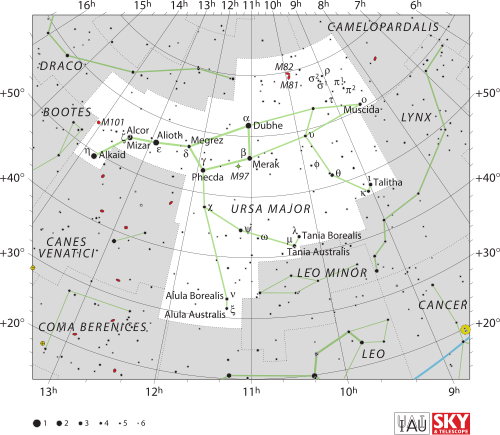 Ursa MajorThe Great Bear and its Big Dipper, the northern sky's most useful signpost.
 CassiopeiaThe Queen's bright W, opposite the Big Dipper, rich in star clusters.
