Sirius
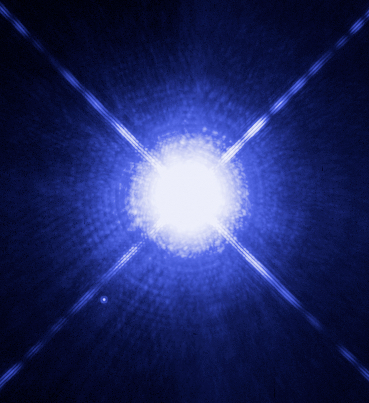
Key facts
| Constellation | Canis Major, the Great Dog |
|---|---|
| Apparent magnitude | −1.46, the brightest star in the night sky |
| Distance | About 8.6 light-years |
| Spectral type | A1 V, a hot white main-sequence star |
| Mass | About 2 times the Sun (Sirius A) |
| Radius | About 1.7 times the Sun |
| Companion | Sirius B, a white dwarf with about the Sun's mass, orbit about 50 years |
| Best evening season at 40°N | December to March, best in January and February |
| How to find it | Follow Orion's Belt down and to the left about 20 degrees |
In short
- Sirius is the brightest star in the night sky, mainly because it is one of our nearest neighbors at about 8.6 light-years.
- It is a hot white star about twice the Sun's mass, paired with a white dwarf, Sirius B, that is smaller than Earth.
- Sirius B was predicted in 1844 from Sirius's wobbling path and first seen in 1862.
- From mid-northern latitudes Sirius stays fairly low, so it often twinkles in flashes of color.
- Its yearly return to the dawn sky marked the season of the Nile flood in ancient Egypt.
How to find it
Sirius is easy once Orion is up. On a winter evening, find the three stars of Orion's Belt in a short straight row. Follow the line they make down and to the left, about two fists at arm's length, or roughly 20 degrees. The dazzling star you reach is Sirius.
From 40°N it never climbs higher than about 33 degrees above the southern horizon. It rises in the southeast in early winter evenings, crosses the south around 9 p.m. in mid-February, and sinks into the southwest by spring. Sirius also forms one corner of the Winter Triangle with Betelgeuse in Orion and Procyon in Canis Minor.
What kind of star it is
Sirius A, the star we see, is a white main-sequence star of type A1. Main sequence means it is still turning hydrogen into helium in its core, as the Sun does. It has about twice the Sun's mass, about 1.7 times its width, and shines roughly 25 times more strongly.
Its great brightness is mostly a matter of distance. At about 8.6 light-years, Sirius is one of the closest stars to the Sun. Many stars that look fainter, such as Rigel, are thousands of times more powerful but hundreds of light-years away.
Notable features: the Pup
In 1844 the German astronomer Friedrich Bessel noticed that Sirius moves across the sky along a slightly wavy path. He concluded that an unseen companion must be pulling on it. On 31 January 1862 the American telescope makers Alvan Clark and his son Alvan Graham Clark spotted that companion while testing a new lens.
The companion, Sirius B or 'the Pup', is a white dwarf: the dense core left behind after a Sun-like star has used up its fuel. Measurements with the Hubble Space Telescope show it has about the Sun's mass packed into a ball about 7,500 miles wide, smaller than Earth. Its surface is about 45,000°F, yet it is roughly 10,000 times fainter than Sirius A.
The two stars circle each other about every 50 years. Sirius B was once the more massive star of the pair, so it aged faster, swelled into a giant and shed its outer layers before settling into its present form.
Name and history
The name comes from the Greek seirios, usually translated as 'glowing' or 'scorching'. Because Sirius rises with the Sun in late summer, the Greeks and Romans linked it with the hottest weeks of the year, which is the origin of the phrase 'dog days'.
In ancient Egypt the star was the goddess Sopdet. Its first appearance in the dawn sky after weeks of absence came around the time the Nile began to flood, and it helped mark the start of the year. Arab astronomers called it al-shira, a name that passed into Ottoman Turkish as Şi'râ. In Turkish folk tradition it is also known as Akyıldız, 'the white star'.
Observing tips
Because Sirius is low for northern observers, its light passes through a thick layer of moving air. This makes it twinkle hard and flash red, green and blue, especially just after it rises. People sometimes report it as a UFO for this reason. Binoculars or a defocused telescope turn the flashes into a lively ribbon of color.
Seeing Sirius B is a real challenge, because the white dwarf sits in the glare of a star 10,000 times brighter. The two were near their widest separation, about 11 arcseconds, in the mid-2020s, which makes this a good decade to try. Observers usually need a telescope of about 8 inches, very steady air and high magnification.
For a gentler target, sweep about 4 degrees south of Sirius with binoculars to find the star cluster M41, a soft patch of dozens of stars.
 VegaThe blue-white summer star that spins fast, hosts a dust disk and was once the pole star.
 BetelgeuseOrion's orange-red supergiant, famous for its Great Dimming and a newly seen companion.
 Polaris, the North StarThe modest star that marks north, pulses every four days and slowly loses its post.
