Polaris, the North Star

Key facts
| Constellation | Ursa Minor, the Little Bear (end of the Little Dipper's handle) |
|---|---|
| Apparent magnitude | About 2.0, varying very slightly |
| Distance | About 430 light-years (estimates vary) |
| Spectral type | F7 Ib, a yellow-white supergiant |
| Mass | About 5 times the Sun |
| Radius | About 46 times the Sun |
| Pulsation period | About 4 days (3.97 days) |
| Best evening season at 40°N | All year; it never sets, about 40° above the northern horizon |
| How to find it | Follow the Big Dipper's two pointer stars about 28 degrees |
In short
- Polaris lies less than a degree from the north celestial pole, so it barely moves while the rest of the sky turns around it.
- It is not especially bright, about magnitude 2, and ranks only around 50th among the brightest stars.
- It is a Cepheid, a supergiant that swells and shrinks every four days, and its surface has dark and bright spots.
- Polaris is a triple star system; one companion is visible in a small telescope.
- Earth's slow wobble moves the pole: Polaris will be closest around 2100, and other stars will take its place over the millennia.
How to find it
Start with the Big Dipper. The two stars at the outer edge of its bowl, Dubhe and Merak, are called the pointers. Follow the line from Merak through Dubhe away from the bowl for about five times the gap between them, roughly 28 degrees. You reach a fairly lonely star of medium brightness: Polaris.
When the Dipper is low in autumn, use Cassiopeia instead. Its W shape sits on the other side of the pole, and Polaris lies roughly halfway between Cassiopeia and the Big Dipper. Polaris's height above your horizon is about equal to your latitude, so from 40°N it stands about 40 degrees up, or four fists at arm's length, above due north.
What kind of star it is
Polaris is a yellow-white supergiant of type F7, about 430 light-years away, although published distances differ. It looks modest only because it is far; it gives off more than a thousand times as much light as the Sun.
A 2024 study using the CHARA array of six linked telescopes in California measured its size and mass. It is about 46 times as wide as the Sun and about 5 times as massive. The same images showed large bright and dark spots on its surface that change over time, something not seen before on a star of this kind.
Notable features
Polaris is the nearest Cepheid variable. Cepheids are pulsating stars that swell and shrink in a steady rhythm, and their pulse period reveals how luminous they are. This makes them key yardsticks for measuring distances to other galaxies. Polaris pulses every 3.97 days, but its brightness changes by less than a tenth of a magnitude, far too little to notice with the eye.
It is also a triple system. A close companion circles it about every 30 years, too near to see without large instruments. A wider companion, Polaris B, is a ninth-magnitude star about 18 arcseconds away, first noted by William Herschel in 1780.
Polaris will not mark north forever. Earth's axis slowly traces a circle on the sky every 26,000 years or so, a motion called precession. Today Polaris sits about two-thirds of a degree from the pole; around 2100 it will be closest, a little under half a degree, and then the pole will drift away. When the pyramids of Giza were built, the pole star was Thuban in Draco, and in roughly 12,000 years bright Vega will be near the pole.
Name and history
The name comes from the Latin stella polaris, 'the pole star'. For sailors and travelers in the Northern Hemisphere it has served for centuries as a fixed sign of north and a quick way to estimate latitude. It even served as a guide star for the Apollo astronauts on their way to the Moon.
Old Turkic peoples pictured the sky turning around a stake driven into it, and called Polaris Demir Kazık, 'the iron stake', or a golden stake, Altın Kazık, around which the stars of the Big Dipper circle as if tied to it. In Turkish it is simply Kutup Yıldızı, the Pole Star.
Observing tips
Polaris is visible all night, every night, from the Northern Hemisphere, but not from south of the equator. Its steady position makes it ideal for practising star hopping and for lining up the mount of a telescope.
To see it is a double star, use a small telescope at moderate power. The faint companion sits close by, and the pair is a classic test for a small telescope of 2 to 3 inches. Binoculars show a small arc of stars near Polaris, nicknamed the Engagement Ring, with Polaris as the diamond.
Try a long-exposure photograph on a tripod aimed north: other stars draw circles around the pole, while Polaris draws only a tiny arc.
 ArcturusThe bright orange giant of spring and summer, found by following the Big Dipper's handle.
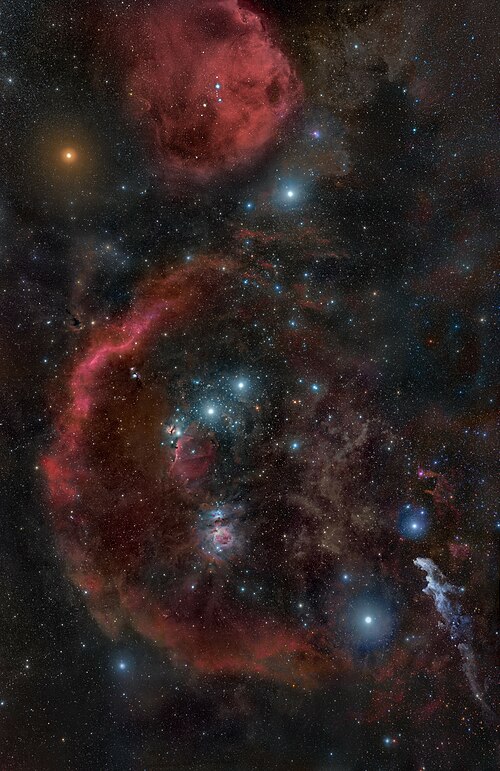 RigelOrion's blue-white supergiant foot, one of the most powerful stars you can see by eye.
 AldebaranThe orange eye of Taurus, a giant star that only seems to sit among the Hyades.
