Arcturus

Key facts
| Constellation | Boötes, the Herdsman |
|---|---|
| Apparent magnitude | −0.05, the fourth brightest star in the night sky |
| Distance | About 37 light-years |
| Spectral type | K1.5 III, an orange giant |
| Mass | About 1 to 1.5 times the Sun |
| Radius | About 25 times the Sun |
| Speed relative to the Sun | About 76 miles per second |
| Best evening season at 40°N | April to August, highest in June |
| How to find it | Follow the curve of the Big Dipper's handle: 'arc to Arcturus' |
In short
- Arcturus is the brightest star north of the celestial equator and the fourth brightest in the whole night sky.
- It is an orange giant: a star with roughly the Sun's mass that has swollen to about 25 times the Sun's width.
- It is racing past the Sun's neighborhood at about 76 miles per second and drifts noticeably against the background over the centuries.
- In 1933 its light was used to switch on the lights of the Chicago World's Fair.
- Its name means 'guardian of the bear', because it follows the Great Bear across the sky.
How to find it
Find the Big Dipper, high in the north on spring evenings. Follow the gentle curve of its handle away from the bowl and keep going about 30 degrees, three fists at arm's length. The bright orange star you reach is Arcturus. Skywatchers remember this as 'arc to Arcturus'. Continue the curve the same distance again to 'speed on to Spica', the blue-white star of Virgo.
From 40°N, Arcturus rises in the northeast on March evenings, stands high in the south around 9 to 10 p.m. in June, and is still visible in the west on late August evenings. Boötes itself, the Herdsman, looks like a kite or an ice-cream cone with Arcturus at its narrow end.
What kind of star it is
Arcturus is an orange giant of type K1.5. It began life as a star much like the Sun, but it has used up the hydrogen in its core. Its core has shrunk while its outer layers have swelled to about 25 times the Sun's width. Its surface is cooler than the Sun's, which gives it a warm orange color, yet because it is so large it shines more than a hundred times as strongly.
This makes Arcturus a preview of the Sun's own future, several billion years from now. In time it will throw off its outer layers as a glowing shell called a planetary nebula, leaving a white dwarf behind.
Notable features
Arcturus is a fast traveler. It moves at about 76 miles per second relative to the Sun, and its position on the sky shifts by about 2.3 arcseconds a year, one of the largest motions of any bright star. That is enough to move it the width of the full Moon in roughly 800 years. At that speed it is only passing through our part of the Galaxy, and it is now close to the nearest point of its path past us.
At about 37 light-years, it is also close enough that its distance and width have been measured directly. The star appears as a tiny disk to specialized instruments, and combining that size with its distance gives its true diameter.
Arcturus has a famous link to modern technology. For the opening of the Century of Progress exposition in Chicago on 27 May 1933, telescopes focused its light onto photoelectric cells, and the tiny current switched on the floodlights. Organizers chose it because its light was thought to have left the star around the time of Chicago's previous World's Fair in 1893; later measurements showed it had actually set out in about 1896.
Name and history
The name comes from the Greek arktouros, 'guardian of the bear', because the star seems to follow Ursa Major, the Great Bear, around the pole. Arab astronomers called it al-simak al-ramih, often translated 'the lance-bearing raiser', a name that appears in Ottoman astronomy texts as es-Simâkü'r-râmih. In Turkish it is usually written Arktürüs.
In Hawaii, Arcturus is Hōkūle'a, 'star of gladness'. It passes almost straight overhead there, which made it a valuable guide for Polynesian navigators sailing toward the islands. The famous double-hulled voyaging canoe Hōkūle'a, which revived traditional Polynesian navigation, is named after it.
Observing tips
Arcturus is bright enough to find from the middle of a city, even in twilight. Its orange tint is clear to the eye, and a pair of binoculars, slightly out of focus, makes it glow like a small ember. Compare it with blue-white Spica or Vega to see how color reveals temperature. The route from the Dipper's handle to Arcturus and on to Spica is the easiest star hop of the spring sky and a good first lesson for beginners.
When it is low just after rising, Arcturus can twinkle strongly and flash colors; later in the evening, high in the sky, it shines steadily. A telescope shows only a bright point, but the view is a good chance to think about how far its light has come: the light you see tonight left Arcturus about 37 years ago.
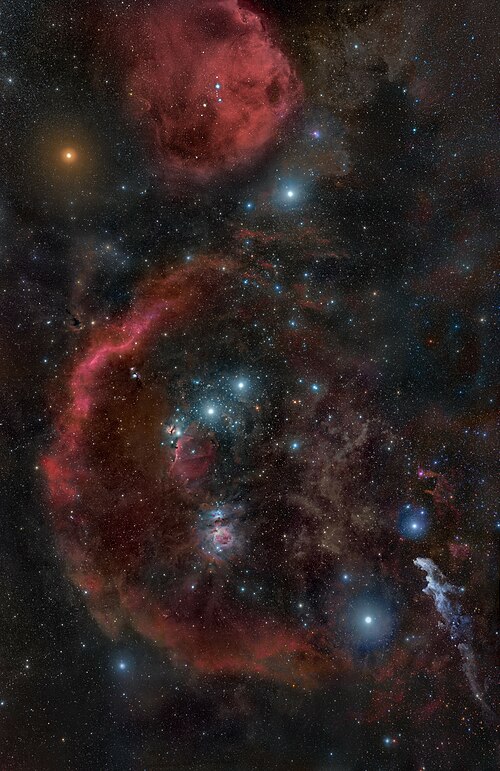 RigelOrion's blue-white supergiant foot, one of the most powerful stars you can see by eye.
 AldebaranThe orange eye of Taurus, a giant star that only seems to sit among the Hyades.
 AntaresThe red heart of the Scorpion, a supergiant rival of Mars with a hidden blue companion.
