Betelgeuse
Key facts
| Constellation | Orion, the Hunter |
|---|---|
| Apparent magnitude | Varies, roughly 0.0 to 1.6 |
| Distance | Roughly 500 to 700 light-years; a 2020 study gives about 530 |
| Spectral type | M1–M2 Ia–Iab, a red supergiant |
| Mass | About 16 to 19 times the Sun |
| Radius | About 750 times the Sun (estimates vary) |
| Best evening season at 40°N | December to March, highest in January |
| How to find it | Orion's upper-left shoulder, above the Belt |
In short
- Betelgeuse is a red supergiant so large that, in the Sun's place, it would reach well beyond the orbit of Mars.
- Its brightness changes slowly over months and years; in early 2020 it faded far more than usual, enough to change Orion's look.
- That Great Dimming was caused by a cloud of dust that formed after the star threw off a huge mass of gas.
- In 2025 astronomers reported the first image of a small companion star, named Siwarha.
- It will end as a supernova, but probably not for about 100,000 years.
How to find it
Find Orion on a winter evening by its three Belt stars. Above the Belt are two shoulder stars; seen from the Northern Hemisphere, the left one, glowing a clear orange-red, is Betelgeuse. Blue-white Rigel sits diagonally opposite at the lower right.
From 40°N, Betelgeuse rises in the east in early evening in December, stands high in the south in January, and sets in the west in spring twilight. Along with Sirius and Procyon it forms the Winter Triangle, and a line from Rigel through Betelgeuse points on toward Castor and Pollux in Gemini.
What kind of star it is
Betelgeuse is a red supergiant: a massive star near the end of its life that has run out of hydrogen in its core and swollen enormously. A 2020 study estimated its mass at about 16 to 19 Suns and its radius at about 750 times the Sun's. If it replaced the Sun, its surface would reach well beyond the orbit of Mars, most of the way to Jupiter.
Its outer layers are cool, around 6,000°F, which is why it looks orange-red. They are also very thin and restless. Huge bubbles of hot gas rise and fall across the surface, and the star pulses on cycles of about 185 days and about 400 days, so its brightness is never quite constant.
Its distance is hard to pin down because the star is large, bright and has a shifting surface, which confuses the usual parallax measurements. Estimates range from about 500 to 700 light-years.
Notable features
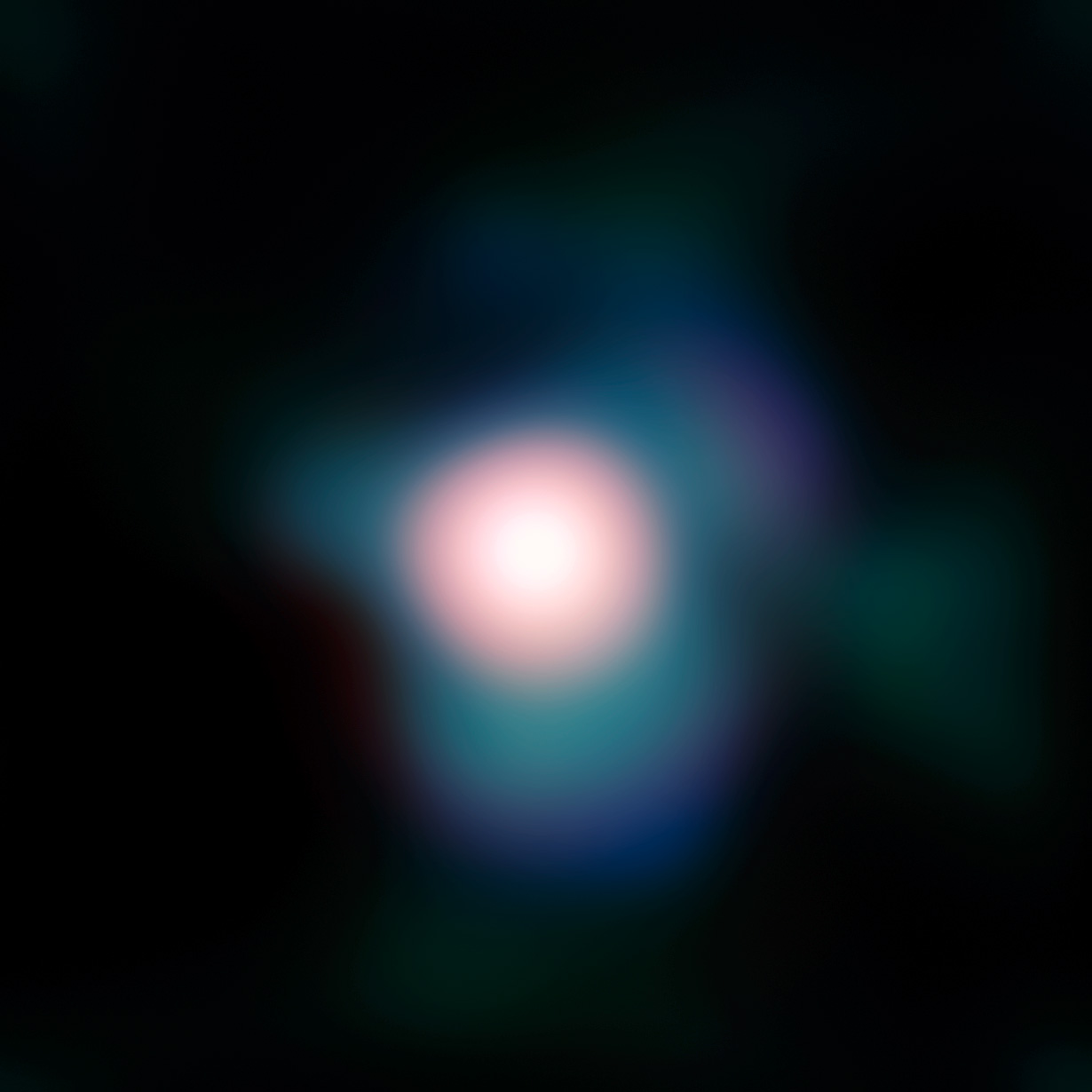
In late 2019 Betelgeuse began to fade, and by February 2020 it had dropped to about magnitude 1.6, so faint that Orion's shape looked visibly different. Some people wondered whether it was about to explode. Images from ESO's Very Large Telescope showed the southern part of the star darkened, and studies concluded that the star had thrown off a large bubble of gas that then cooled into a cloud of dust, veiling part of the star from us. It recovered its normal brightness by April 2020.
For years astronomers suspected that Betelgeuse had a small companion, because it showed a long brightness cycle of about six years. In July 2025 a team using the Gemini North telescope in Hawaii reported a faint companion very close to the edge of the supergiant. It was named Siwarha, 'her bracelet'. It should be easiest to study again around November 2027, when it reaches its widest separation.
Betelgeuse will explode as a supernova, but the 2020 study suggests it is in an early stage of helium burning, likely more than 100,000 years from that end. When it does go, it will be bright enough to see in daylight, but at its distance it poses no danger to Earth.
Name and history
The name is usually traced to the Arabic yad al-jawza, 'the hand of al-Jawza', a central figure of old Arabic sky lore. A misreading of the Arabic script in medieval Latin turned 'yad' into the 'Bet' that survives today. The companion's name, Siwarha, continues the same picture of a hand with a bracelet.
Although it is usually brighter than Rigel, Betelgeuse carries the label Alpha Orionis. The German astronomer Johann Bayer assigned these Greek letters in 1603, and he did not always follow strict order of brightness. Its slow changes in brightness were already noted by the astronomer John Herschel in the 1830s.
Observing tips
Betelgeuse is a showcase for star color. Compare its warm orange glow with Rigel's cool blue-white on the opposite corner of Orion; the contrast is clear even from a bright city. Slightly out-of-focus binoculars make the colors even stronger.
Try tracking its brightness yourself. Compare Betelgeuse with nearby stars of known magnitude, such as Procyon (about 0.4), Aldebaran (about 0.9) and Bellatrix (about 1.6), and note which it matches. Repeat every week or two through the winter, and you join a long tradition of amateur variable-star observers.
No telescope will show it as anything but a point of light; even the largest instruments needed special techniques to resolve its disk and its companion.
Sources
- ESO — Mystery of Betelgeuse's dip in brightness solved (eso2109)
- NASA JPL — NASA scientist finds predicted companion star to Betelgeuse
- Kavli IPMU — Study of supergiant star Betelgeuse recalibrates its mass, radius and distance
- Dupree et al. (2022) — The Great Dimming of Betelgeuse: a surface mass ejection
- AAVSO — Variable Star of the Season: Alpha Orionis (Betelgeuse)
 Polaris, the North StarThe modest star that marks north, pulses every four days and slowly loses its post.
 ArcturusThe bright orange giant of spring and summer, found by following the Big Dipper's handle.
 RigelOrion's blue-white supergiant foot, one of the most powerful stars you can see by eye.
