Moons of the Solar System
Key facts
| Planets with no moons | Mercury and Venus |
|---|---|
| Jupiter's moons | About 101 known as of 2026 |
| Saturn's moons | About 285 known as of 2026, the most of any planet |
| Uranus and Neptune | 29 and 16 known moons as of 2026 |
| Largest moon | Ganymede, about 3,273 miles wide, bigger than Mercury |
| Most volcanic world | Io, with more than 400 active volcanoes |
| Only moon with a thick atmosphere | Titan, denser than Earth's air at the surface |
| Likely ocean worlds | Europa, Enceladus, Ganymede, Titan and possibly others |
| Equipment needed | Binoculars for Jupiter's four big moons; a small telescope for Titan |
In short
- As of 2026 astronomers know of roughly 430 moons orbiting the planets, and the count keeps rising as faint, small ones are found.
- Most new discoveries are tiny, irregular moons only a few miles across, probably captured or broken off from larger bodies.
- Europa and Enceladus hide salty oceans of liquid water under their ice, making them top targets in the search for life.
- Titan has rivers, lakes and seas, but they are filled with liquid methane and ethane, not water.
- You can see Jupiter's four largest moons with steady binoculars and watch them change position from night to night.
How many moons are there?
A moon is any natural object that orbits a planet, dwarf planet or asteroid. Earth has one and Mars has two small ones, Phobos and Deimos, while Mercury and Venus have none.
The giant planets are a different story. As of 2026, Saturn leads with about 285 known moons and Jupiter has about 101. Uranus has 29 and Neptune 16. Together that is roughly 430 moons around the planets, plus many more around dwarf planets and asteroids.
These numbers change often. Large telescopes keep turning up small moons only a mile or two across, and each must be tracked for months or years before it is officially confirmed. Treat any moon count as a snapshot rather than a final answer.
Regular and irregular moons
Astronomers sort moons into two broad families. Regular moons, like Jupiter's big four, follow nearly circular orbits close to their planet and in the same direction it spins. They most likely formed from a disk of gas and dust around the young planet.
Irregular moons orbit far out on tilted, stretched paths, and many travel backward. Most of the recent discoveries belong to this group. They are thought to be captured objects or fragments from ancient collisions, so they carry clues about the early Solar System.
Ocean worlds: Europa and Enceladus
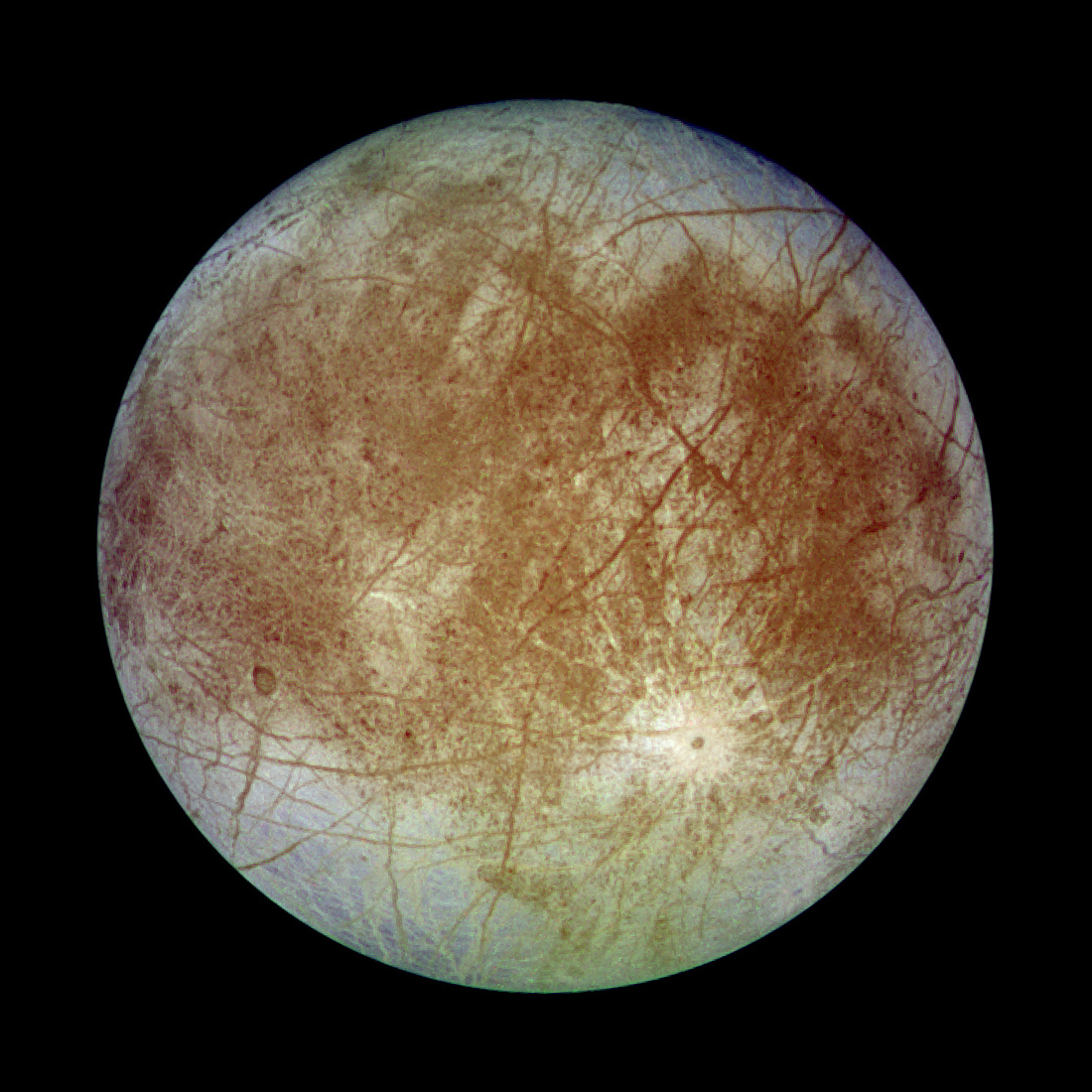
Jupiter's moon Europa is a little smaller than our Moon and covered by a cracked shell of ice. Measurements of its magnetic field and surface suggest a global salty ocean underneath, holding perhaps twice as much water as all of Earth's oceans.
Saturn's Enceladus is only about 313 miles wide, yet it shoots jets of water vapor and ice grains from long cracks near its south pole. NASA's Cassini spacecraft flew through these plumes and found salts, silica and organic molecules, signs of an ocean in contact with a rocky seafloor.
Liquid water, energy and the right chemistry are the basic ingredients for life as we know it. That is why NASA's Europa Clipper, launched in 2024, is on its way to Jupiter and is due to arrive in 2030. ESA's JUICE mission, launched in 2023, will study Europa, Callisto and especially Ganymede from the early 2030s.
Titan: a world with weather
Titan, Saturn's largest moon, is about 3,200 miles wide and wrapped in a thick orange haze of nitrogen. Its surface air pressure is about one and a half times Earth's.
At about −290°F, water is rock-hard ice there. Instead, methane and ethane fall as rain, carve river channels and pool in lakes and seas near the poles. Titan is the only place besides Earth known to have stable liquid on its surface.
Scientists also think Titan hides a water ocean deep inside. NASA's Dragonfly mission, a nuclear-powered drone, is planned to launch in 2028 and fly between sites on Titan's surface in the 2030s.
Io, Ganymede and Triton
Io, the innermost of Jupiter's big moons, is the most volcanically active world we know. Jupiter's gravity, together with tugs from Europa and Ganymede, squeezes and flexes Io, heating its interior. More than 400 volcanoes paint its surface yellow, red and black with sulfur and lava.
Ganymede is the largest moon in the Solar System, wider than the planet Mercury. It is the only moon known to make its own magnetic field, and it probably has a buried ocean sandwiched between layers of ice.
Neptune's Triton orbits backward, opposite to the planet's spin, which strongly suggests it was a Kuiper Belt object captured long ago. When Voyager 2 flew past in 1989 it saw dark plumes rising from a frozen surface at about −391°F, one of the coldest measured in the Solar System.
How to see other planets' moons
Jupiter's four largest moons, Io, Europa, Ganymede and Callisto, are called the Galilean moons because Galileo spotted them in 1610. Hold binoculars steady, ideally braced on a wall or tripod, and you will see up to four tiny star-like points in a line beside the planet.
Look again a few hours later or the next night and their positions will have shifted. Sometimes one hides behind Jupiter or passes in front of it. Free planetarium apps show which moon is which on any given night.
A small telescope also reveals Titan as a faint point near Saturn, usually within a few ring-widths of the planet. The moons of Uranus and Neptune, including Triton, need a larger telescope, dark skies and a good chart. Use the article on seeing planets to check when each giant is well placed.
 Space WeatherSolar flares, CMEs and geomagnetic storms: how the Sun's outbursts reach Earth.
 The SunOur home star: a nuclear furnace that lights, warms and shapes the whole Solar System.
 The MoonEarth's rocky companion, born from a giant impact and covered in craters and lava plains.
