The Moon
Key facts
| Average distance from Earth | About 238,855 miles |
|---|---|
| Diameter | About 2,159 miles, roughly a quarter of Earth's |
| Surface gravity | About 1/6 of Earth's |
| Orbit and rotation | Both about 27.3 days, so one side always faces us |
| Cycle of phases | About 29.5 days |
| Surface temperature | About 250°F in sunlight to about −208°F at night |
| Age | About 4.5 billion years |
| People who have walked on it | 12, during Apollo missions 1969–1972 |
| Equipment needed | None; binoculars or a small telescope add a lot |
In short
- The Moon most likely formed from debris thrown out when a Mars-sized body hit the young Earth about 4.5 billion years ago.
- The dark patches are maria, old plains of hardened lava; the bright areas are older, heavily cratered highlands.
- The Moon spins once for every orbit, so the same side always faces Earth.
- Twelve astronauts walked on the Moon between 1969 and 1972 and brought back about 842 pounds of rock and soil.
- The best views are along the terminator, the line between day and night, where shadows make craters stand out.
Our nearest neighbor
The Moon is Earth's only natural satellite and the brightest object in the night sky. It orbits at an average distance of about 238,855 miles, close enough that light from it reaches us in about 1.3 seconds.
It is about a quarter as wide as Earth, which makes it unusually large compared with its planet. Its gravity, only about one sixth of ours, still raises the ocean tides and slowly steadies the tilt of Earth's axis.
The Moon has almost no atmosphere, so nothing shields its surface. In sunlight the ground heats to about 250°F, and at night it drops to roughly −208°F.
How the Moon formed
The leading idea is the giant impact hypothesis. About 4.5 billion years ago, a body roughly the size of Mars, often called Theia, struck the young Earth at a glancing angle. The collision threw a huge cloud of molten and vaporized rock into orbit, and that material gradually gathered into the Moon.
Rock samples back this up. Moon rocks are chemically very similar to Earth's mantle, yet the Moon has only a small iron core, which fits a body made largely from Earth's outer layers. Scientists still debate the details, such as how much of the Moon came from Theia.
Maria, craters and highlands
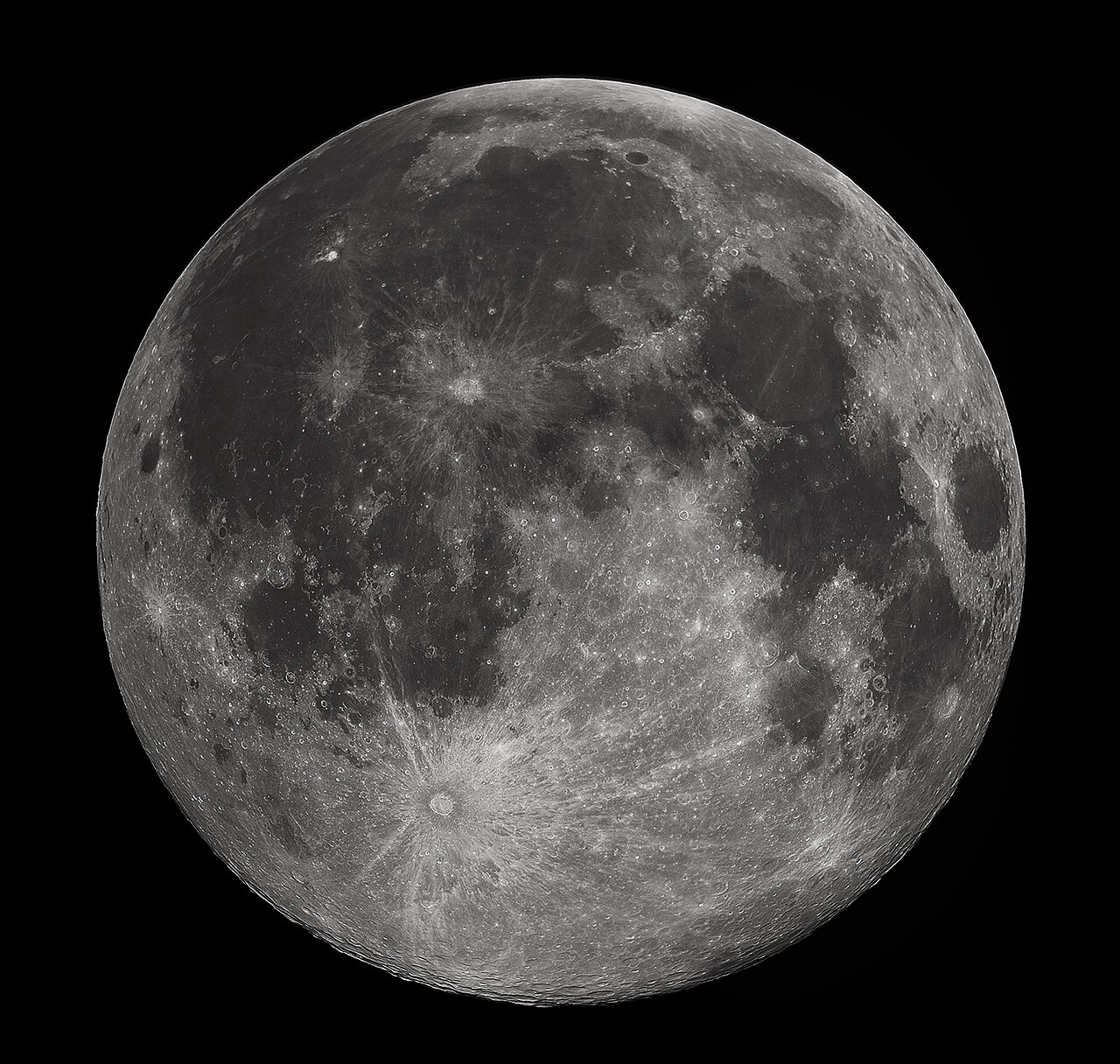
Look at the full Moon and you will see dark gray patches. Early astronomers thought they were seas and named them maria (Latin for seas; singular mare). They are actually vast plains of basalt, lava that flooded huge impact basins more than 3 billion years ago.
The brighter regions are the highlands, the Moon's older crust. They are packed with craters because, without wind, water or plate tectonics, almost nothing erases the scars of impacts. Some craters, like Tycho, have bright rays of debris that stretch hundreds of miles.
The surface is covered in regolith, a layer of fine, sharp dust and broken rock made by billions of years of small impacts. The astronauts' footprints are still there, because there is no weather to wipe them away.
Why we always see the same side
The Moon turns on its axis in about 27.3 days, exactly the time it takes to orbit Earth. This is called synchronous rotation or tidal locking. Over billions of years, Earth's gravity slowed the Moon's spin until the two periods matched.
So the far side is not dark; it gets as much sunlight as the near side, we just never see it from Earth. A slight wobble in the Moon's orbit, called libration, lets us peek at about 59% of the surface over time. The far side was first photographed by a Soviet probe in 1959.
The Apollo landings
On July 20, 1969, Apollo 11 astronauts Neil Armstrong and Buzz Aldrin became the first people to walk on the Moon. Between 1969 and 1972, six Apollo missions landed, and 12 astronauts explored the surface.
They brought back about 842 pounds of lunar rock and soil, which are still being studied today and are the main reason we know the Moon's age and origin. As of 2026, NASA's Artemis program aims to send astronauts back, this time to the region near the Moon's south pole, where ice may hide in permanently shadowed craters.
How to observe the Moon
The Moon needs no special equipment and is easy to find, even from a bright city. With the naked eye you can trace the maria and, around full Moon, the bright rays of Tycho.
Steady binoculars change everything. You will see dozens of craters, mountain ranges along the edges of the maria and the rough texture of the highlands. A small telescope at low power reveals crater walls, central peaks and long, winding valleys called rilles.
The best place to look is along the terminator, the boundary between the sunlit and dark parts of the Moon. There the Sun is low on the lunar horizon, so even small hills cast long shadows and the landscape looks three-dimensional. At full Moon the light falls straight down and the surface looks flat and washed out.
Good times to observe are a few days after new Moon through first quarter, when the crescent is up in the evening. Watch the same area on consecutive nights and you will see the terminator move, revealing new features as the sunrise sweeps across the surface.
If the bright Moon feels dazzling in a telescope, don't worry; it is harmless. A neutral moon filter or a bit more magnification makes the view more comfortable around full Moon.
 Dwarf planets and PlutoRound worlds too small to clear their orbits: Pluto, Ceres, Eris, Haumea and Makemake.
 AsteroidsRocky leftovers from the birth of the planets, from tiny boulders to 330-mile Vesta.
 CometsIcy leftovers from the birth of the Solar System that grow glowing tails near the Sun.
