Asteroids
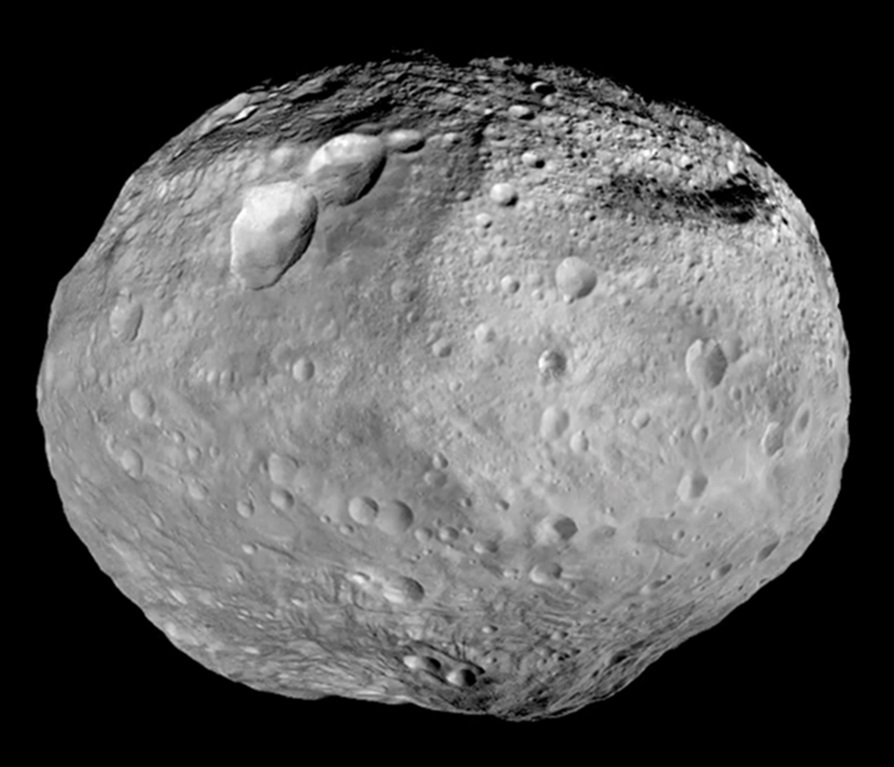
Key facts
| Known asteroids (as of 2026) | More than 1.4 million |
|---|---|
| Main belt location | Between Mars and Jupiter, about 2.2–3.3 AU from the Sun |
| Largest in the belt | Ceres (a dwarf planet), about 590 miles across |
| Largest true asteroid | Vesta, about 330 miles across |
| Main types | C (carbon-rich), S (stony), M (metallic) |
| Planetary defense test | DART hit Dimorphos on Sept. 26, 2022; orbit shortened by about 32 minutes |
| Sample returned | OSIRIS-REx delivered Bennu material on Sept. 24, 2023 |
| Brightest to the eye | Vesta, up to about magnitude 5.2 |
In short
- Asteroids are rocky or metallic bodies left over from the formation of the planets about 4.6 billion years ago.
- Most orbit in the main belt between Mars and Jupiter, but the belt is mostly empty space.
- Near-Earth asteroids are tracked closely; no known asteroid poses a significant impact threat in the next 100 years.
- NASA's DART mission proved in 2022 that hitting an asteroid can change its orbit.
- Vesta, the brightest asteroid, can be seen in binoculars and sometimes with the naked eye from a dark site.
What is an asteroid?
An asteroid is a small rocky or metallic body that orbits the Sun. Asteroids are leftovers from the disk of dust and rock that built the planets about 4.6 billion years ago. Some never grew into anything larger, so they preserve clues about the early Solar System.
They range from boulders a few feet across to Vesta, about 330 miles wide. Only the largest are round; most are lumpy, and many are rubble piles, loose collections of rock held together by weak gravity. Unlike comets, asteroids contain little ice, so they do not grow glowing tails near the Sun.
The main asteroid belt
Most known asteroids orbit in the main belt, a broad zone between Mars and Jupiter. Jupiter's strong gravity stirred up this region early on and kept its material from forming a planet.
Films often show the belt as a crowded field of tumbling rocks, but it is mostly empty. The average distance between sizable asteroids is hundreds of thousands of miles, and spacecraft cross it without any special maneuvering. All the asteroids in the belt put together have less mass than our Moon, and Ceres alone holds about a quarter of it.
Other groups exist too. The Trojans share Jupiter's orbit, gathered in two swarms ahead of and behind the planet. NASA's Lucy spacecraft is on its way to visit several of them.
Types of asteroids
Astronomers sort asteroids by how they reflect light, which hints at what they are made of. C-type asteroids are dark and rich in carbon; they are the most common, especially in the outer belt. S-type asteroids are brighter and made of stony silicate minerals and some metal.
M-type asteroids look metallic and may be iron-rich fragments of shattered planetary cores. NASA's Psyche mission, launched in 2023, is traveling to the large metal-rich asteroid 16 Psyche and is expected to arrive in 2029.
Meteorites, pieces of asteroids that survive the fall to Earth, let scientists study these materials directly in the lab.
Near-Earth asteroids and planetary defense
Some asteroids have orbits that bring them near Earth's path. These near-Earth asteroids number more than 37,000 as of 2026. Survey telescopes find new ones every week, and NASA's Center for Near Earth Object Studies calculates their orbits decades ahead.
Small objects hit Earth all the time and mostly burn up as meteors. Larger impacts are rare, but they have shaped Earth's history. No known asteroid poses a significant risk of hitting Earth in the next 100 years, yet many smaller ones remain undiscovered.
To test a defense, NASA flew the DART spacecraft into Dimorphos, a small moon of the asteroid Didymos, on September 26, 2022. The impact shortened Dimorphos's orbit by about 32 minutes, far more than the minimum goal. It was the first time humans changed the motion of a natural body in space. ESA's Hera mission, launched in 2024, is due to study the aftermath in late 2026.
OSIRIS-REx and the Bennu sample
NASA's OSIRIS-REx spacecraft reached the near-Earth asteroid Bennu in 2018. In 2020 it briefly touched the surface and collected dust and pebbles. The surface turned out to be so loose that the sampling arm sank in as if pressing into a ball pit.
The capsule landed in the Utah desert on September 24, 2023, carrying about 4.3 ounces of material, the largest asteroid sample ever returned. Studies have found water-bearing minerals and organic molecules, including amino acids, the building blocks of proteins. Japan's Hayabusa2 had earlier returned a smaller sample from asteroid Ryugu.
How to spot a bright asteroid
Through any telescope an asteroid looks like a star; the giveaway is that it moves. The easiest target is Vesta. At its best it reaches about magnitude 5.2, just at the edge of naked-eye visibility from a truly dark site, and it is easy in binoculars.
First find out where Vesta is this month using a planetarium app or a sky guide, and print or save a finder chart showing the stars around it. Locate the field in binoculars and note the pattern of faint stars.
Look again one or two nights later. The point that has shifted against the other stars is Vesta. Ceres, Pallas and Juno can be found the same way when they are well placed, though they are fainter. Asteroids are best seen around opposition, when Earth passes between them and the Sun and they shine all night.
 CometsIcy leftovers from the birth of the Solar System that grow glowing tails near the Sun.
 Meteors, meteor showers and meteoritesShooting stars explained: what burns up, why showers return each year, and when to watch.
 The SunOur home star: a nuclear furnace that lights, warms and shapes the whole Solar System.
