Space Weather

Key facts
| What drives it | The Sun's magnetic activity and the solar wind |
|---|---|
| Flare classes | A, B, C, M and X, each ten times stronger than the last |
| CME travel time to Earth | Usually about 1 to 3 days |
| Flare light travel time | About 8 minutes |
| Storm scale | NOAA G1 (minor) to G5 (extreme) |
| Kp index | 0 (quiet) to 9 (extreme); G1 starts at Kp 5 |
| Current solar cycle | Cycle 25, began December 2019 |
| Cycle 25 status | Past its maximum (around late 2024) and declining as of 2026 |
| Official US forecasts | NOAA Space Weather Prediction Center |
In short
- Space weather is the changing conditions in space caused by the Sun, from steady solar wind to sudden eruptions.
- Solar flares are bursts of light and radiation; coronal mass ejections are huge clouds of magnetized gas that take days to arrive.
- When a CME hits Earth's magnetic field it can trigger a geomagnetic storm, bringing auroras far from the poles.
- Strong storms can disturb radio, GPS, satellites and power grids, so forecasters watch the Sun around the clock.
- Solar Cycle 25 peaked around late 2024; as of 2026 activity is declining, but big storms are still possible.
What space weather means
On Earth, weather is the state of the air around us. Space weather is the same idea for the space around our planet: how much charged gas, radiation and magnetic disturbance is flowing past at any moment.
Almost all of it comes from the Sun. A constant stream of charged particles, the solar wind, blows outward at about 1 million mph. Now and then the Sun adds sudden outbursts that can shake Earth's magnetic field. Our atmosphere and magnetic field protect people on the ground, but technology in orbit and on the ground can feel the effects.
Solar flares
A solar flare is a sudden flash of energy near a sunspot, where tangled magnetic fields snap and reconnect. It releases X-rays and ultraviolet light that reach Earth in about 8 minutes.
Flares are ranked by their X-ray brightness into classes A, B, C, M and X. Each letter is ten times stronger than the one before, and numbers refine the scale, so an X2 flare is twice as strong as an X1.
Strong flares can ionize the upper atmosphere on Earth's dayside and cause shortwave radio blackouts lasting minutes to hours. NOAA rates these on its R-scale, from R1 to R5. Some flares also accelerate protons to high speeds, creating a solar radiation storm, rated S1 to S5, which matters most for astronauts, polar flights and satellites.
Coronal mass ejections
A coronal mass ejection, or CME, is a vast bubble of magnetized plasma, often billions of tons of it, thrown off from the Sun's outer atmosphere. Many CMEs come with flares, but not all.
CMEs travel much more slowly than light. Most take about one to three days to cross the roughly 93 million miles to Earth, and the fastest can arrive in under a day. Space-based coronagraphs, which block the Sun's bright disk, let forecasters see CMEs leave and estimate when they will arrive.
Whether a CME causes trouble depends on its speed and, above all, the direction of its magnetic field. If that field points opposite to Earth's, the two connect and energy pours into our magnetosphere.
Geomagnetic storms, Kp and the G-scale
A geomagnetic storm is a major disturbance of Earth's magnetic field. The Kp index measures it on a scale from 0 to 9 using magnetometers around the world, updated every three hours.
NOAA's Space Weather Prediction Center turns this into a simple G-scale. Kp 5 is a G1 (minor) storm, Kp 6 is G2, Kp 7 is G3, Kp 8 is G4 and Kp 9 is G5 (extreme). The higher the level, the farther from the poles auroras can appear.
Extreme storms are rare. The May 2024 storm reached G5, the first in more than 20 years, and auroras were seen across much of the United States and Europe. The most famous historical storm, the Carrington Event of 1859, sparked telegraph systems and produced auroras near the tropics.
Effects on technology and people
Storms induce electric currents in long power lines and pipelines. In March 1989 a strong storm knocked out Quebec's power grid for about nine hours. Grid operators now receive alerts and can adjust their systems in advance.
Satellites feel space weather too. Storms heat and expand the upper atmosphere, increasing drag; in February 2022 dozens of newly launched internet satellites fell back to Earth after a modest storm. GPS accuracy, shortwave radio and airline communications on polar routes can also suffer.
Astronauts face higher radiation during solar radiation storms, so crews on the space station can shelter in better-shielded areas. On the ground, our atmosphere keeps us safe, and the main visible effect is a beautiful aurora.
Solar Cycle 25 and how to follow it
The Sun's activity rises and falls over roughly 11 years, tracked by counting sunspots. Solar Cycle 25 began in December 2019. NASA and NOAA announced in October 2024 that the Sun had reached its maximum period, and as of 2026 activity is slowly declining.
That does not mean the show is over. Some of the strongest storms of past cycles happened during the declining phase, when large, complex sunspot groups still appear.
To follow space weather, check the NOAA Space Weather Prediction Center's free dashboard for the latest Kp, alerts and a 3-day forecast. For aurora hunting, a predicted G1 or higher is worth watching for at high latitudes, and G3 or more for mid-latitudes. If you want to see sunspots yourself, use only a proper solar filter; see our guide to observing the Sun safely.
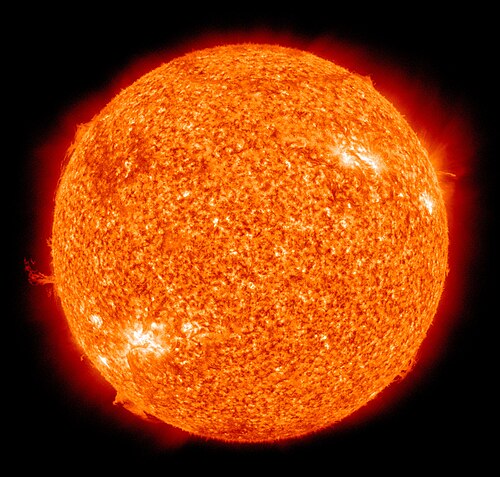 The SunOur home star: a nuclear furnace that lights, warms and shapes the whole Solar System.
 The MoonEarth's rocky companion, born from a giant impact and covered in craters and lava plains.
 Dwarf planets and PlutoRound worlds too small to clear their orbits: Pluto, Ceres, Eris, Haumea and Makemake.
