Leo

Key facts
| IAU abbreviation | Leo |
|---|---|
| Size | 12th largest of the 88 constellations |
| Brightest star | Regulus (Alpha Leo), magnitude about 1.4, about 79 light-years away |
| Best evening season (about 40°N) | March to May, high in the south |
| Visible latitudes | Between about +90° and −65° |
| Notable deep-sky objects | Leo Triplet (M65, M66, NGC 3628), M95, M96, M105 |
| Famous asterism | The Sickle, a backward question mark |
| Mythology origin | Mesopotamian lion; Greek Nemean Lion |
| Equipment needed | Eyes for the shape; a small telescope for the galaxies |
In short
- Leo is one of the few constellations that really looks like what it is named after: a crouching lion.
- Its head is the Sickle, a backward question mark of stars ending in bright Regulus.
- Regulus lies almost exactly on the ecliptic, so the Moon and planets often pass close to it.
- Leo sits away from the Milky Way, so it offers a clear view out to distant galaxies.
- The Leonid meteor shower in mid-November appears to come from the Sickle.
The lion of spring
Leo, the Lion, is a zodiac constellation that rules the evening sky in spring. When it rises in the east after dark in February and March, many observers take it as a sign that winter is ending.
Unlike many star patterns, Leo needs little imagination. A curved line of stars forms the lion's head and mane, and a triangle of stars to the east forms its hindquarters and tail. The Sun passes in front of Leo from about mid-August to mid-September.
How to find it
Start from the Big Dipper, high in the north on spring evenings. The two pointer stars at the front of the bowl lead to Polaris. Follow them the other way, away from Polaris, and after about five fists you reach Leo.
Look for a backward question mark of six stars, the Sickle. The dot at its bottom is Regulus, the brightest star in Leo. About 25 degrees east of Regulus, roughly two and a half fists, the fainter Denebola marks the tail.
From 40°N, in April around 10 p.m., Leo stands about 60 degrees above the southern horizon, high enough to escape most haze.
If you know the winter constellations better, there is another route: on spring evenings, Regulus is the brightest star roughly halfway between the twin stars of Gemini, Castor and Pollux, and Spica in Virgo.
The main stars and their names
Regulus (Alpha Leonis) shines at magnitude about 1.4 and lies about 79 light-years away. Its name is Latin for 'little king', given by Copernicus. It spins so fast that it bulges at its equator, completing a turn in under 16 hours.
Denebola (Beta Leonis), at magnitude about 2.1 and 36 light-years, takes its name from the Arabic for 'the lion's tail'. Algieba (Gamma Leonis), magnitude about 2.0 in the Sickle, is a fine double star: a small telescope splits it into two golden suns.
Zosma (Delta Leonis), on the lion's back, has a name thought to mean 'girdle'. Together with Denebola and Chertan it forms the triangle of the lion's rear.
Deep-sky objects for binoculars and small telescopes
Because Leo lies far from the dusty plane of the Milky Way, we look out of our galaxy here and see other galaxies. Most are faint, so they are best for a small telescope under dark skies.
The Leo Triplet sits below the lion's hind leg, between Chertan and Iota Leonis. M65 and M66 are two spiral galaxies about 35 million light-years away, and they fit in one low-power view; NGC 3628, a thin edge-on spiral, is the third and faintest.
Below the lion's belly, roughly halfway between Regulus and the hindquarters, lie M95, M96 and M105, another small group of galaxies. In a small telescope they look like soft, oval glows rather than spirals.
Mythology
Lion figures in this part of the sky go back to ancient Mesopotamia. In Egypt the Sun was in Leo during the hottest weeks, when the Nile flooded and lions came down from the desert to drink, which may have strengthened the link.
In Greek myth Leo is the Nemean Lion, a beast with skin no weapon could pierce. Heracles strangled it as the first of his twelve labors and wore its hide as armor. Hera, or Zeus in some versions, then placed the lion among the stars.
In Turkish the constellation is called Aslan. Arab astronomers once imagined an even larger lion that stretched over neighboring stars.
Calling Regulus a 'king' is an old idea too: in Mesopotamia and later in Europe it was counted among the four 'royal stars' of the sky.
Practical observing tips
Leo is well placed from March to May, around 9 to 11 p.m. Even from a suburb, the Sickle and Regulus are easy to see; the triangle of the hindquarters needs darker skies.
Watch Regulus over several nights when the Moon or a bright planet is nearby. Because it sits almost on the ecliptic, the Moon sometimes covers it, an event called an occultation.
For the galaxies, wait for a moonless night and use low magnification first. Look slightly to one side of the target, a trick called averted vision, which brings out faint light.
Mark your calendar for the Leonids around November 17. The shower is usually modest, with perhaps 10 to 15 meteors an hour, but it has produced famous meteor storms, as in 1833, 1966 and 1999. The Sickle rises after midnight in November, so the best viewing is in the hours before dawn.
 TaurusThe Bull of winter: orange Aldebaran, the Hyades V and the Pleiades star cluster.
 GeminiThe Twins Castor and Pollux, the cluster M35 and the home of the Geminid meteors.
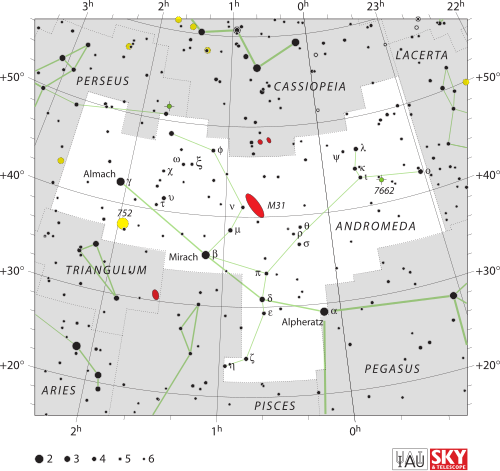 AndromedaThe Chained Princess and the Andromeda Galaxy, the most distant thing your eyes can see.
