Galaxies
Key facts
| Milky Way diameter | About 100,000 light-years |
|---|---|
| Stars in the Milky Way | About 100 to 400 billion |
| Sun's distance from the galactic center | About 26,000 light-years |
| Time for the Sun to orbit the galaxy | About 230 million years |
| Distance to Andromeda (M31) | About 2.5 million light-years |
| Andromeda's approach speed | About 250,000 mph |
| Galaxies in the Local Group | More than 80, most of them dwarfs |
| Galaxies in the observable universe | Estimated at about 200 billion to 2 trillion |
In short
- A galaxy is a huge system of stars, gas, dust and dark matter bound together by gravity.
- The Milky Way is a barred spiral about 100,000 light-years across, and the Sun sits in one of its outer arms.
- Galaxies come in three broad shapes: spiral, elliptical and irregular.
- Andromeda is heading toward us, but recent studies give a full merger in the next 10 billion years only about even odds.
- On a dark, moonless night you can see Andromeda with the naked eye as a faint smudge.
What is a galaxy?
A galaxy is a giant collection of stars, gas, dust and dark matter, all held together by gravity. Dark matter is an invisible substance that does not give off light but whose pull we can measure; it makes up most of a galaxy's mass.
Galaxies range from dwarfs with a few million stars to giants with more than a trillion. Most large galaxies have a supermassive black hole at the center.
Until about a century ago, many astronomers thought the Milky Way was the whole universe. In the 1920s Edwin Hubble showed that some fuzzy "nebulae" were in fact separate galaxies far beyond our own.
Our home: the Milky Way
The Milky Way is a barred spiral galaxy: a flat, rotating disk with spiral arms wound around a central bar of stars. It is about 100,000 light-years across and holds roughly 100 to 400 billion stars.
The Sun lies about 26,000 light-years from the center, in a smaller arm called the Orion Spur. Moving at about 515,000 mph, it takes around 230 million years to complete one lap around the galaxy.
Because we sit inside the disk, we see it edge-on as a pale, glowing band across the sky. That band is the combined light of billions of distant stars, broken up by dark lanes of dust.
Seeing the Milky Way band
You need a truly dark sky, away from city lights and with no Moon. Give your eyes 20 to 30 minutes to adjust, and avoid looking at your phone screen.
From mid-northern latitudes, the brightest part of the band, toward the galactic center in Sagittarius, is best from about May to August, highest around midnight in June and July. In winter you can still see a fainter stretch running through Cassiopeia, Perseus and Orion.
A photo with a long exposure will show far more detail than your eyes, but seeing it in person for the first time is hard to forget.
Galaxy types
Spiral galaxies have a bright central bulge and a flat disk with arms where new stars are forming. Many, like the Milky Way, have a bar of stars across the middle.
Elliptical galaxies are smooth, rounded or egg-shaped clouds of mostly old, reddish stars with little gas left for new ones. The largest galaxies known are giant ellipticals, often found at the hearts of galaxy clusters.
Irregular galaxies have no clear shape, often because a neighbor's gravity has pulled them around. The Large and Small Magellanic Clouds, visible from the Southern Hemisphere, are well-known examples.
Andromeda and the Local Group
The Milky Way belongs to a small gang of galaxies called the Local Group, spread over about 10 million light-years. It contains more than 80 known members, mostly small dwarf galaxies.
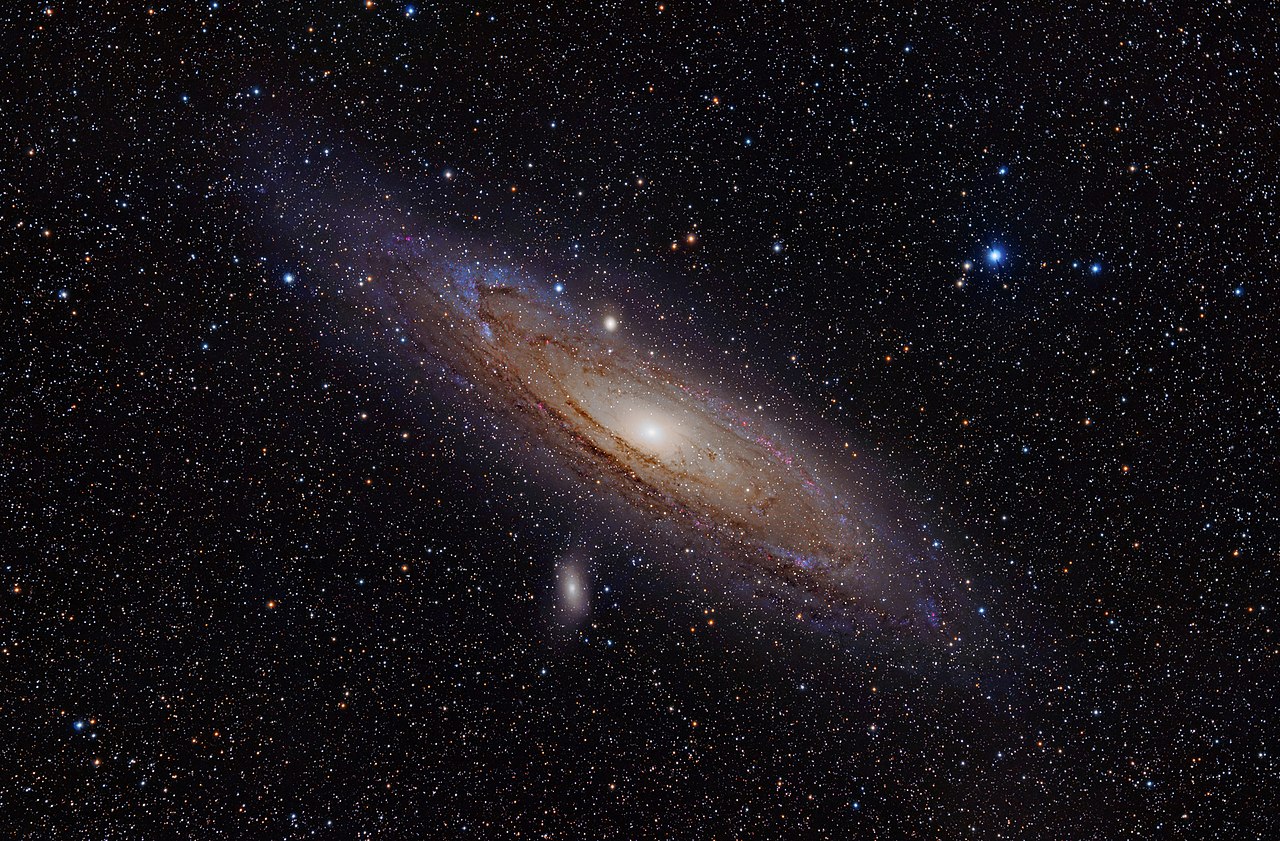
The two biggest members are the Milky Way and the Andromeda Galaxy, also called M31. Andromeda is a spiral about 2.5 million light-years away and somewhat larger than our galaxy. The third largest is the Triangulum Galaxy, M33.
Andromeda is moving toward us at about 250,000 mph. For years, astronomers expected a head-on collision and merger in about 4 to 5 billion years. A 2025 study using Hubble and Gaia data, which also accounted for the pull of M33 and the Large Magellanic Cloud, found roughly even odds of a merger within the next 10 billion years. So the crash is possible, but no longer certain.
Even if it happens, stars are so far apart that almost none would hit each other. The two galaxies would slowly blend, probably into one large elliptical.
How many galaxies are there?
Astronomers estimate the number by taking very deep images of tiny patches of sky, counting the galaxies, and scaling up. The Hubble Deep Field images of the 1990s and later revealed thousands of galaxies in a patch smaller than a grain of sand held at arm's length.
Estimates for the observable universe range from about 200 billion to as many as 2 trillion galaxies, depending on how many faint, small ones are counted. The James Webb Space Telescope, launched in 2021, now sees galaxies that formed only a few hundred million years after the Big Bang and is helping refine these numbers.
How to see Andromeda yourself
Andromeda is the most distant thing most people can see with the naked eye. From a dark site it looks like a faint, elongated smudge, larger than you might expect.
In the Northern Hemisphere it is best seen in autumn evenings, roughly September to December. Find the Great Square of Pegasus, then follow the line of stars running from its corner star, Alpheratz, toward Cassiopeia. Andromeda sits just above the second of those stars, Mirach.
Binoculars make it much easier: you will see the bright, oval core. A small telescope can show its two companion galaxies, M32 and M110. The light you see left Andromeda about 2.5 million years ago.
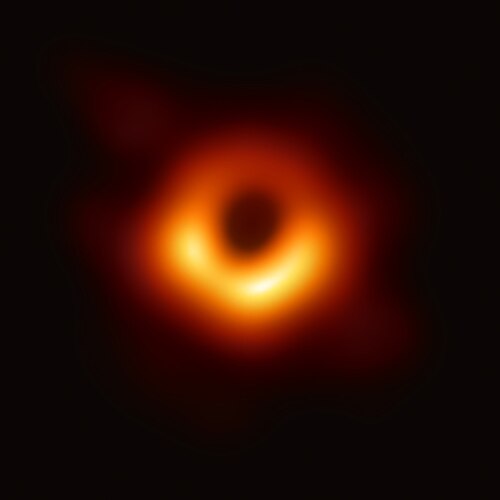 Black holesPlaces where gravity is so strong that not even light can escape.
 Moon phasesWhy the Moon changes shape over a month, and which phases are best for observing.
 Solar and lunar eclipsesHow the Sun, Moon and Earth line up to cast shadows, and how to watch eclipses safely.
