Solar and lunar eclipses
Key facts
| Solar eclipse | The Moon blocks the Sun; only at new Moon |
|---|---|
| Lunar eclipse | Earth's shadow falls on the Moon; only at full Moon |
| Moon's orbital tilt | About 5° to Earth's orbit |
| Eclipses per year | At least 4 (2 solar, 2 lunar), up to 7 |
| Longest possible totality (solar) | About 7.5 minutes |
| Totality of a lunar eclipse | Can last over 1.5 hours |
| Safe solar viewing | Certified filters meeting ISO 12312-2 only |
| Next total solar eclipse | 2 August 2027 (Spain, North Africa, Egypt) |
| Next total lunar eclipse | 31 December 2028 – 1 January 2029 |
In short
- A solar eclipse happens when the Moon passes between the Sun and Earth; a lunar eclipse when Earth's shadow falls on the Moon.
- Eclipses do not happen every month because the Moon's orbit is tilted about 5° to Earth's orbit.
- During a total lunar eclipse the Moon turns coppery red, lit by sunlight bent through Earth's atmosphere.
- Never look at a partial or annular solar eclipse without a certified ISO 12312-2 solar filter.
- The total solar eclipse of 2 August 2027 crosses southern Spain, North Africa and Egypt, and Türkiye sees a partial eclipse.
How eclipses work
An eclipse happens when the Sun, Earth and Moon line up closely enough that one body casts its shadow on another. In a solar eclipse, the Moon moves between the Sun and Earth, and its shadow sweeps across part of Earth's surface. In a lunar eclipse, Earth sits between the Sun and the Moon, and the Moon slides into Earth's shadow.
A shadow from a body lit by a large light source has two parts. The umbra is the dark central core, where the light is fully blocked. The penumbra is the lighter outer part, where only some of the light is blocked. What you see depends on which part of the shadow reaches you or the Moon.
The Sun is about 400 times wider than the Moon but also about 400 times farther away. This coincidence makes them look almost the same size in our sky, which is why the Moon can just cover the Sun.
Types of solar eclipse
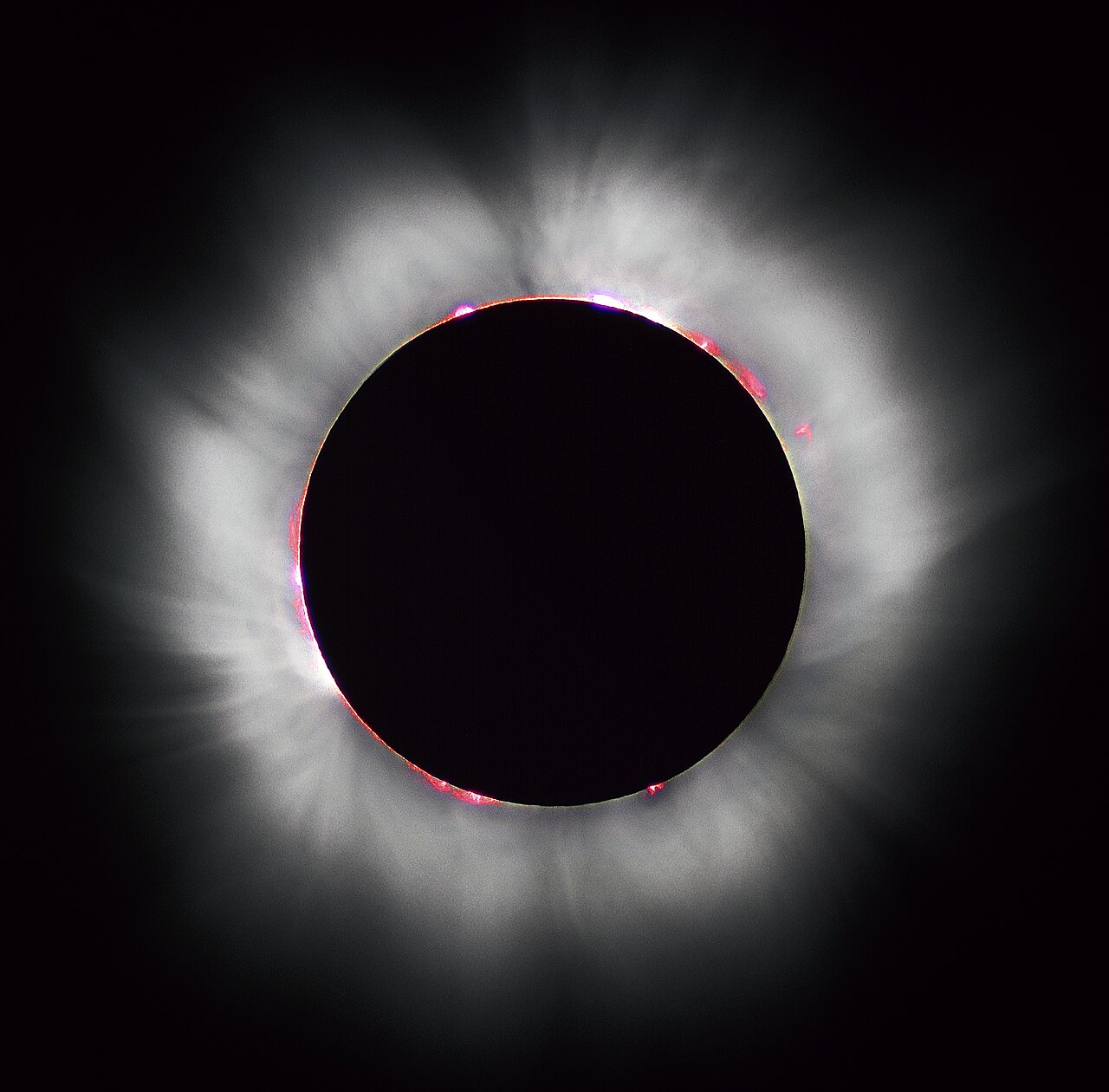
Total: the Moon completely covers the Sun's bright disk. The sky darkens, bright stars and planets appear, and the Sun's pearly outer atmosphere, the corona, becomes visible. Totality is seen only from a narrow path, often about 100 miles wide, and lasts at most about 7.5 minutes, usually much less.
Partial: the Moon covers only part of the Sun, which looks like a bitten cookie. Everyone outside the path of totality but within the wider penumbra sees this.
Annular: the Moon is near the far point of its orbit and looks a bit smaller than the Sun, so it leaves a bright ring, sometimes called the ring of fire. Hybrid: a rare eclipse that shifts between annular and total along its path because of Earth's curved surface; the last one was on 20 April 2023.
Types of lunar eclipse
Total: the whole Moon passes into Earth's umbra. Partial: only part of the Moon enters the umbra, and a dark bite appears on one edge. Penumbral: the Moon passes only through the faint outer shadow and dims so slightly that many people do not notice.
Unlike a solar eclipse, a lunar eclipse can be seen by everyone on the night side of Earth at the same time. It also unfolds slowly: the full event can last several hours, with totality sometimes exceeding an hour and a half.
Why not every month?
If the Moon orbited in exactly the same plane as Earth, we would get a solar eclipse at every new Moon and a lunar eclipse at every full Moon. But the Moon's orbit is tilted about 5° to Earth's orbit around the Sun. Most months, the new Moon passes a little above or below the Sun, and the full Moon misses Earth's shadow.
Eclipses can happen only when a new or full Moon occurs near one of the two points where the Moon's orbit crosses Earth's orbital plane, called nodes. This lines up about twice a year, in windows called eclipse seasons. That is why eclipses often come in pairs, a solar and a lunar eclipse about two weeks apart.
Why a blood moon is red
During a total lunar eclipse, the Moon does not vanish. It usually turns orange, copper or deep red. Sunlight passing through Earth's atmosphere is bent toward the Moon, and on the way blue light is scattered out, the same effect that makes sunsets red. In effect, the Moon is lit by all of Earth's sunrises and sunsets at once.
The exact color and brightness depend on how much dust, cloud and volcanic ash is in the atmosphere. After a large eruption, an eclipsed Moon can look very dark. A lunar eclipse is completely safe to watch with your eyes, binoculars or a telescope.
Watching a solar eclipse safely
Looking at the Sun, even when it is mostly covered, can permanently damage your eyes, often without pain. During all partial and annular phases, use only certified solar viewing glasses or filters that meet the ISO 12312-2 standard. Regular sunglasses, smoked glass and exposed film are not safe.
Never look at the Sun through binoculars, a telescope or a camera unless a certified solar filter covers the front of the instrument. Eclipse glasses worn behind binoculars do not protect you. A simple pinhole projector, such as a small hole in a card that casts an image of the Sun onto paper, is a safe indirect method.
Only during the brief total phase, when the Sun's disk is completely covered, can you safely remove the filter and look. Put it back on as soon as the first bright point of sunlight returns. With an annular eclipse, there is no safe moment without a filter.
Upcoming notable eclipses
The total solar eclipse of 12 August 2026 crossed Greenland, western Iceland and northern Spain, with totality lasting up to about 2 minutes 18 seconds. Much of Europe saw a deep partial eclipse.
The next one is the total solar eclipse of 2 August 2027, often called the eclipse of the century. Its path crosses southern Spain, Gibraltar, Morocco, Algeria, Tunisia, Libya, Egypt, Saudi Arabia and Yemen. Near Luxor, Egypt, totality lasts about 6 minutes 23 seconds, the longest on land this century. Türkiye sees a partial eclipse around midday.
Other dates to note as of 2026: an annular solar eclipse on 6 February 2027 over South America and Africa, an annular eclipse over Spain and Portugal on 26 January 2028, a total solar eclipse across Australia and New Zealand on 22 July 2028, and a total lunar eclipse on 31 December 2028 to 1 January 2029, visible from Europe, Africa and Asia. Check local times closer to each date.
 Why we have seasonsEarth's tilt, not its distance from the Sun, gives us summer and winter.
 Auroras: the northern and southern lightsHow the solar wind and Earth's magnetic field paint the polar skies.
 Gravity and orbitsWhy planets circle the Sun, why the Moon never falls, and what keeps JWST in place.
