Moon phases

Key facts
| Synodic month (new Moon to new Moon) | About 29.5 days |
|---|---|
| Sidereal month (one orbit vs. the stars) | About 27.3 days |
| Average distance from Earth | About 238,900 miles |
| Main phases | New, first quarter, full, last quarter |
| Moon is always half lit | By the Sun; we see a changing part of that half |
| Rises each day | About 50 minutes later on average |
| Earthshine best seen | Thin crescent, a few days before or after new Moon |
| Best phases for telescopes | Crescent to gibbous, along the terminator |
| Equipment needed | Eyes; binoculars or a small telescope for detail |
In short
- The Moon makes no light of its own; half of it is always lit by the Sun, and phases show how much of that half faces us.
- One full cycle of phases, the synodic month, takes about 29.5 days.
- Waxing means the lit part is growing toward full Moon; waning means it is shrinking toward new Moon.
- The crescent looks tilted or flipped depending on your latitude and hemisphere, but the phase is the same for everyone.
- Full Moon is the worst time to see craters; the line between light and dark near quarter phases shows the most detail.
Why the Moon has phases
The Moon shines only by reflecting sunlight. At any moment, the Sun lights exactly half of it, just as it lights half of Earth during day. What changes over the month is how much of that sunlit half we can see from Earth.
As the Moon orbits Earth, the angle between the Sun, Earth and Moon changes. When the Moon sits roughly between us and the Sun, its lit side faces away and we see almost nothing: new Moon. When it is on the far side of Earth from the Sun, we see the whole lit face: full Moon. Everything in between is a partial view.
A common myth says Earth's shadow causes the phases. It does not. Earth's shadow only touches the Moon during a lunar eclipse, which is a separate and much rarer event.
The 29.5-day cycle
The Moon takes about 27.3 days to go once around Earth measured against the distant stars. This is the sidereal month. But during that time Earth also moves along its orbit around the Sun, so the Moon needs about two more days to line up with the Sun again. That longer cycle, about 29.5 days from one new Moon to the next, is the synodic month, and it sets the rhythm of the phases.
The word month comes from Moon, and many calendars, including the Islamic and Hebrew calendars, are based on this cycle. Because the Moon moves east along its orbit, it rises on average about 50 minutes later each day.
The names of the phases
New Moon: the Moon is near the Sun in the sky and its dark side faces us, so it is usually invisible. Waxing crescent: a thin sliver appears in the evening sky after sunset and grows each night.
First quarter: about a week after new Moon, half of the disk is lit. It is called a quarter because the Moon has gone a quarter of the way around its orbit. Waxing gibbous: more than half is lit, and the bulging shape grows toward full.
Full Moon: about two weeks after new Moon, the whole face is lit. It rises around sunset and stays up all night. After that comes the waning gibbous, then last quarter (also called third quarter), when the other half is lit and the Moon rises around midnight. Finally a waning crescent appears in the morning sky before dawn, shrinking until the next new Moon.
Waxing, waning and the hemisphere twist
Waxing means growing and waning means shrinking. From the Northern Hemisphere, a waxing Moon is lit on the right and a waning Moon on the left. An old memory trick in English uses the letters D and C: a lit shape like D on the right means growing, like C means shrinking.
From the Southern Hemisphere, the picture is flipped, because observers there see the Moon upside down compared with northern viewers. A waxing Moon is lit on the left. Near the equator, a crescent often looks like a boat or a smile, lying almost flat, because of the way the Moon's path meets the horizon at those latitudes.
The phase itself is the same for everyone on Earth on the same night. Only its orientation in your sky changes.
Earthshine
When the Moon is a thin crescent, you can often see the rest of its disk glowing faintly. This soft gray light is called earthshine. Sunlight reflects off Earth's clouds, oceans and ice, travels to the Moon, lights its night side and bounces back to us.
Earthshine is easiest to see a few days before or after new Moon, in the evening or morning twilight. Leonardo da Vinci explained it correctly about 500 years ago. Its brightness changes slightly with Earth's cloud cover, so scientists have even used it to study Earth's climate.
Best phases for observing
Full Moon looks bright and beautiful, but it is the hardest time to see craters. With the Sun shining straight down on the side facing us, there are almost no shadows, and features look flat.
The most detail appears along the terminator, the line between the lit and dark parts. There, the Sun is low on the lunar horizon and long shadows make craters, mountains and valleys stand out sharply. The days around first and last quarter are excellent, and a crescent or gibbous Moon is also rewarding.
If you want to see faint stars, galaxies or meteor showers, plan around the new Moon, when the sky is darkest. Full Moon is good for evening walks and moonrise photos, especially when it is near the horizon and looks golden.
How to observe the Moon
The Moon is the easiest object in the sky to observe: you can do it from a city, even through light haze. With only your eyes, follow the phase from night to night and note where and when the Moon rises.
Binoculars already show large craters and the dark plains called maria. A small telescope reveals mountain ranges and crater walls in sharp detail. The Moon can be uncomfortably bright in a telescope, so a lower magnification or a simple Moon filter helps. A smartphone held to the eyepiece can take good photos. When the young crescent is close to the setting Sun, wait until the Sun is fully below the horizon before pointing binoculars or a telescope.
 Solar and lunar eclipsesHow the Sun, Moon and Earth line up to cast shadows, and how to watch eclipses safely.
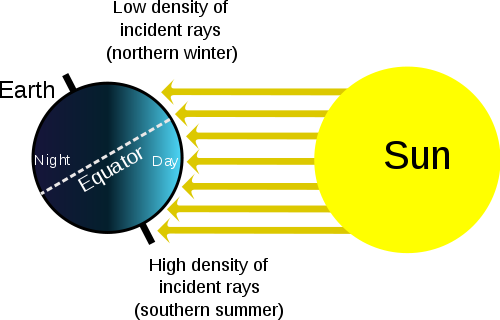 Why we have seasonsEarth's tilt, not its distance from the Sun, gives us summer and winter.
 Auroras: the northern and southern lightsHow the solar wind and Earth's magnetic field paint the polar skies.
