Virgo

Key facts
| IAU abbreviation | Vir |
|---|---|
| Size | 2nd largest of the 88 constellations, after Hydra |
| Brightest star | Spica (Alpha Vir), magnitude about 1.0, about 250 light-years away |
| Best evening season (about 40°N) | April to June, highest in May |
| Visible latitudes | Between about +80° and −80° |
| Zodiac | The Sun passes through Virgo from about mid-September to the end of October |
| Notable deep-sky objects | Virgo Cluster, M87, M49, M60, M104 Sombrero Galaxy, quasar 3C 273 |
| Mythology origin | Mesopotamian goddess with an ear of grain; Greek Demeter, Persephone or Astraea |
| Equipment needed | Eyes for Spica; a small telescope and a dark sky for the galaxies |
In short
- Virgo is the largest zodiac constellation and the second largest of all, but only Spica is bright.
- From the Big Dipper, 'arc to Arcturus, then speed on to Spica' leads you straight to Virgo.
- Spica is two hot stars orbiting each other in about four days, so close that both are stretched out of round.
- The Virgo Cluster, more than 1,000 galaxies about 55 million light-years away, lies on the border with Coma Berenices.
- M87, a giant galaxy in the cluster, hosts the first black hole ever imaged, shown to the public in 2019.
The Maiden of spring
Virgo, the Maiden, is a zodiac constellation that spreads across a wide stretch of the spring sky. It covers more area than any other constellation except Hydra, yet apart from Spica its stars are modest, so the full figure is hard to see from towns.
The Sun spends longer in Virgo than in any other zodiac constellation, from about mid-September to the end of October. The point where the Sun crosses the celestial equator heading south each year, the September equinox, currently lies in Virgo.
How to find it
Use the Big Dipper. Follow the curve of its handle to orange Arcturus in Boötes, then continue the same curve about the same distance again to a blue-white star low in the south: that is Spica. Skywatchers remember the route as 'arc to Arcturus, speed on to Spica'.
From 40°N in May, around 10 p.m., Spica stands about 35 degrees above the southern horizon. The rest of Virgo forms a lopsided Y north and west of Spica, with the bowl of the Y opening toward Leo's tail star Denebola.
Because Virgo lies on the ecliptic, the Moon and planets often pass through it. A bright 'extra star' in Virgo is usually a planet.
The main stars and their names
Spica (Alpha Virginis) shines at magnitude about 1.0 and lies about 250 light-years away. Its Latin name means 'ear of grain', the wheat the Maiden holds. It is a close pair of hot, blue-white stars that orbit each other in about four days; they are so close that each is pulled into an egg shape, and the system's brightness wobbles slightly.
Porrima (Gamma Virginis), magnitude about 2.7 and about 38 light-years away, is two nearly equal stars that circle each other every 169 years. They were closest together in 2005 and are now slowly widening, so a small telescope can split them again.
Vindemiatrix (Epsilon Virginis), magnitude about 2.8, takes its name from the Latin for 'grape gatherer'. In ancient times it rose before dawn around the start of the grape harvest.
Galaxies for small telescopes
The triangle between Vindemiatrix, Denebola in Leo and the star cluster of Coma Berenices is the realm of the galaxies. The Virgo Cluster contains more than 1,000 galaxies about 55 million light-years away, and it is the heart of the larger group that includes our own Local Group.
Its brightest members, the giant ellipticals M87, M49 and M60, look like soft round glows in a small telescope. A curving line of galaxies called Markarian's Chain is a fine sight at low power under dark skies. M87 became famous in 2019, when the Event Horizon Telescope revealed the shadow of its central black hole, about 6.5 billion times the mass of the Sun.
On the southern border with Corvus, the Sombrero Galaxy, M104, about 30 million light-years away, is a spiral seen almost edge-on with a dark dust lane across its bright core. It is not a member of the Virgo Cluster. Virgo also holds 3C 273, the first quasar ever identified, about magnitude 13 and more than 2 billion light-years away.
Mythology
In Mesopotamia these stars were linked to a furrow in a field and to a goddess holding an ear of grain. Greek and Roman writers often saw the Maiden as Demeter, the Roman Ceres, goddess of agriculture, or as her daughter Persephone. When Hades took Persephone to the underworld, Demeter's grief brought winter; her daughter's yearly return brought spring.
Another story makes her Astraea, goddess of justice, the last of the immortals to leave Earth as people grew cruel. The scales of Libra, next to Virgo, are sometimes said to be hers. In Turkish the constellation is called Başak, which means an ear of grain.
Practical observing tips
Spica is bright enough for any sky; from a city it may be the only star of Virgo you see. Watch for the Moon passing close to it, since on some months the Moon can cover Spica, an event called an occultation.
For galaxy hunting, wait for a moonless spring night and a site with dark southern skies. Start at Denebola, sweep slowly east at low magnification and use averted vision, looking slightly to one side of a faint object to see it better. Do not expect spiral arms: most Virgo galaxies look like faint gray smudges, but each one holds billions of stars.
 AquilaThe Eagle of summer nights, led by Altair, one of the closest bright stars.
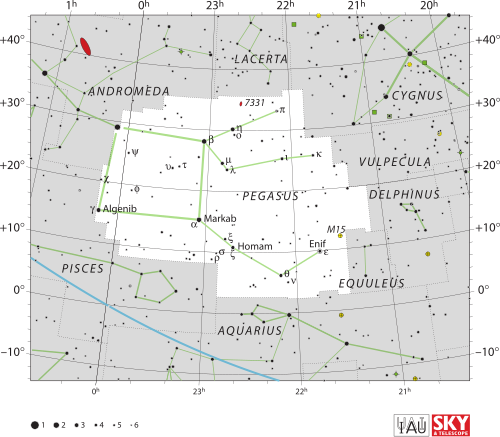 PegasusThe autumn winged horse, with its Great Square and a star that hosted a famous planet.
 PerseusThe hero of autumn and winter skies, with the 'winking' star Algol and the Double Cluster.
