Aquila

Key facts
| IAU abbreviation | Aql |
|---|---|
| Size | 22nd largest of the 88 constellations |
| Brightest star | Altair (Alpha Aql), magnitude about 0.76, about 17 light-years away |
| Best evening season (about 40°N) | July to September, highest in August |
| Visible latitudes | Between about +90° and −75° |
| Famous asterism | Southern corner of the Summer Triangle, with Vega and Deneb |
| Notable deep-sky objects | Milky Way star clouds, Barnard's E dark nebula, NGC 6709, NGC 6751 |
| Mythology origin | Babylonian eagle; Greek eagle that carried Zeus's thunderbolts |
| Equipment needed | Eyes; binoculars for the Milky Way, a telescope for the nebulae |
In short
- Altair is the southern corner of the Summer Triangle and one of the nearest stars visible to the naked eye.
- Two fainter stars sit on either side of Altair in a short straight line, a pattern that makes Aquila easy to recognize.
- Altair spins once in about 10 hours or less, so fast that it bulges at its equator.
- Eta Aquilae is a Cepheid whose brightness changes by almost a magnitude in about 7 days, enough to follow by eye.
- Aquila lies along the Milky Way, so binoculars show rich star fields and dark dust clouds.
An eagle in the Milky Way
Aquila, the Eagle, flies along the summer Milky Way, south of Cygnus and Lyra. Its brightest star, Altair, forms the southern corner of the Summer Triangle, the big triangle of bright stars that rules the sky from July to October.
The constellation straddles the celestial equator, so it is visible from almost everywhere on Earth. From the north it stands in the south-east on July evenings and in the south in August; from the southern hemisphere it is a winter constellation, seen upside down.
How to find it
Find the Summer Triangle first. Vega in Lyra is the brightest of its three stars and the highest on summer evenings. Deneb in Cygnus is the corner to the north-east. The third and most southerly corner, about 34 degrees from Vega, is Altair.
Altair is easy to confirm, because it has a fainter star close on each side: orange Tarazed to the north-west and Alshain to the south-east. The three stand in a short line, about 5 degrees long, sometimes called the Family of Aquila. From there the eagle's wings spread to either side, and its tail points north-west toward the dark rift of the Milky Way.
The main stars and their names
Altair (Alpha Aquilae) shines at magnitude about 0.76 and lies about 17 light-years away, making it one of the closest stars you can see without optics. Its name comes from the Arabic for 'the flying eagle'. It is a white star nearly twice the mass of the Sun.
Altair rotates in about 10 hours or less, compared with about 25 days for the Sun. This fast spin flattens it, so it is at least 14 percent wider at its equator than from pole to pole. In 2007 astronomers using the CHARA array of telescopes in California made one of the first images of the surface of a star like this, showing a brighter, hotter pole and a darker equator.
Tarazed (Gamma Aquilae), magnitude about 2.7, is an orange giant much farther away than Altair. Alshain (Beta Aquilae), magnitude about 3.7, is a yellowish star about 45 light-years away.
A pulsating star and a famous nova
Eta Aquilae, south of Altair, is one of the first Cepheid variables ever found; the English astronomer Edward Pigott noticed its changes in 1784. It brightens and fades between about magnitude 3.5 and 4.4 every 7.2 days. Compare it night by night with nearby steady stars of similar brightness and you can watch the cycle yourself.
In June 1918 a 'new star' appeared in Aquila and for a few days rivaled the brightest stars in the sky. Nova Aquilae 1918 was a white dwarf in a close binary system flaring up as it pulled gas from its partner. It faded from view within months and is now far too faint for the eye.
Deep-sky objects for binoculars and small telescopes
Sweep the Milky Way through Aquila with binoculars and you will see dense star clouds broken by dark lanes of dust. Near Tarazed, under a dark sky, look for Barnard's E, a dark nebula shaped like the letter E, a cloud of dust that blocks the stars behind it.
The open cluster NGC 6709, about magnitude 6.7, is a small, rich patch for binoculars or a small telescope. The Glowing Eye Nebula, NGC 6751, is a planetary nebula, a shell of gas thrown off by a dying star, about magnitude 12 and about 6,500 light-years away; it needs a medium telescope.
Mythology
An eagle in this part of the sky goes back to Babylonian astronomy. In Greek myth Aquila is the eagle of Zeus, which carried his thunderbolts. In one story Zeus, in eagle form, carried the young Ganymede to Mount Olympus to serve as cup-bearer to the gods; Ganymede is often linked with neighboring Aquarius.
In East Asian tradition Altair is the herdsman who meets the weaver girl Vega once a year across the Milky Way. In Turkish the constellation is called Kartal, the Eagle.
Practical observing tips
Aquila is best in August and September, from about 9 p.m. to midnight. Altair is bright enough for any city, but the wings and the Milky Way need a dark site and a moonless night.
To follow Eta Aquilae, pick two comparison stars, one slightly brighter and one slightly fainter, and note each night whether Eta looks closer to one or the other. After a week or two you will have seen a full cycle. Binoculars on a tripod make the dark nebulae much easier to see.
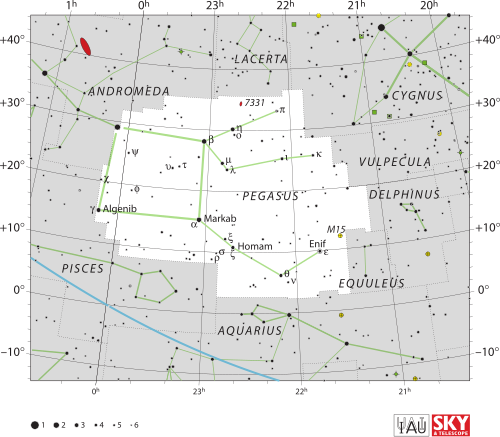 PegasusThe autumn winged horse, with its Great Square and a star that hosted a famous planet.
 PerseusThe hero of autumn and winter skies, with the 'winking' star Algol and the Double Cluster.
 AurigaThe winter Charioteer: golden Capella, a strange eclipsing star and three clusters.
