Speed of light

Key facts
| Speed of light in a vacuum | 299,792,458 m/s (exact, by definition) |
|---|---|
| In everyday units | About 186,282 miles per second |
| Per hour | About 671 million miles per hour |
| Sunlight to Earth | About 8 minutes 20 seconds |
| Moonlight to Earth | About 1.3 seconds |
| Signal between Earth and Mars | About 3 to 22 minutes one way |
| First estimate | Ole Rømer, 1676, using Jupiter's moon Io |
| Value fixed by definition | 1983, when the meter was redefined |
In short
- Light in empty space travels exactly 299,792,458 meters per second, about 186,000 miles every second.
- Rømer first showed in 1676 that light takes time to travel, by timing eclipses of Jupiter's moon Io.
- Anything with mass would need infinite energy to reach light speed, so it never can.
- Sunlight is about 8 minutes 20 seconds old when it reaches you.
- The farther away an object is, the older the light we see from it.
How fast is light?
Light moving through empty space covers exactly 299,792,458 meters every second. In imperial units that is about 186,282 miles per second, or roughly 671 million miles per hour.
The word exactly matters here. Since 1983 the meter itself has been defined using light: one meter is the distance light travels in 1/299,792,458 of a second. So the speed is no longer something we measure more precisely each year. It is a fixed number, and our rulers are built around it.
Light slows down when it passes through materials. In water it moves at about three quarters of its vacuum speed, and in glass about two thirds. When scientists say "the speed of light" without more detail, they mean the speed in a vacuum, usually written as the letter c.
Rømer and the moons of Jupiter
For most of history, people assumed light arrived instantly. The first good evidence against that came in 1676 from the Danish astronomer Ole Rømer, working at the Paris Observatory.
Rømer was timing Io, the innermost large moon of Jupiter. Io slips into Jupiter's shadow on a regular schedule, about every 42.5 hours. He noticed that these eclipses came a little early when Earth was moving toward Jupiter and a little late when Earth was moving away.
His explanation was simple and bold. When Earth is farther from Jupiter, the light from Io has extra distance to cover, so the news of each eclipse reaches us later. Rømer put the delay across the full width of Earth's orbit at about 22 minutes; the true figure is closer to 17. The Dutch scientist Christiaan Huygens combined that delay with the estimated size of Earth's orbit and got about 131,000 miles per second. The number was too low, but the key idea was right: light has a finite speed.
Fizeau, Michelson and precise numbers
In 1849 the French physicist Hippolyte Fizeau measured light speed on Earth for the first time. He shone a beam through the gaps of a fast spinning toothed wheel toward a mirror about 5 miles away. At the right spin rate, the returning light was blocked by the next tooth. From the wheel speed and the distance he got a value within about 5 percent of the modern one.
Later in the 1800s and into the 1920s, the American physicist Albert Michelson refined the method with rotating mirrors. In one famous series he sent light between two California mountains about 22 miles apart. His results came within a few tenths of a mile per second of today's value. Michelson became the first American to win a Nobel Prize in physics, in 1907, largely for this kind of precision optical work.
Why nothing with mass can reach it
Einstein's special theory of relativity, published in 1905, explains why light speed acts as a cosmic speed limit. One of its central ideas is that light moves at the same speed for every observer, no matter how fast that observer is moving.
A consequence is that pushing an object with mass gets harder the faster it goes. Close to light speed, each extra push adds less and less speed. To reach light speed exactly, the object would need an infinite amount of energy, which no rocket or particle accelerator can supply.
Light itself has no mass, so it always travels at c. The Large Hadron Collider pushes protons to more than 99.9999 percent of light speed, yet they never quite get there.
Light travel times in space
Because space is so large, even light needs time to cross it. Sunlight leaves the Sun and reaches Earth about 8 minutes and 20 seconds later. Light reflected from the Moon takes only about 1.3 seconds.
Mars is a good example of how this affects real missions. Depending on where the two planets are in their orbits, a radio signal takes roughly 3 to 22 minutes to travel one way. A rover driver on Earth cannot steer in real time, so rovers carry out planned commands and use their own software to avoid hazards.
Farther out, the delays grow. Voyager 1, the most distant spacecraft, is so far away that its signals take close to a full day to reach us.
Looking at the sky means looking into the past
Every time you see something in the sky, you see it as it was when its light set out. The Sun you see is the Sun of about 8 minutes ago. A bright star like Sirius appears as it was more than 8 years ago.
For galaxies the effect becomes huge. Light from the Andromeda Galaxy left it about 2.5 million years ago. The James Webb Space Telescope collects light that started its trip more than 13 billion years ago, so astronomers can study young galaxies as they looked soon after the universe began.
This is one of the most useful tools in astronomy. Distance and time are linked, so the deep sky works like a layered history book, with older chapters farther away.
 Light-yearA unit of distance, not time: how far light travels in one year.
 Solar SystemThe Sun, eight planets, dwarf planets and icy belts, from Mercury to the Oort Cloud.
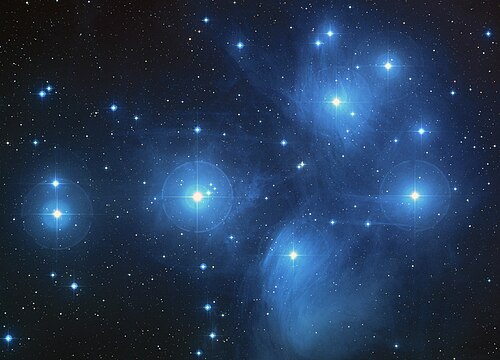 What are stars?Giant balls of hot gas powered by nuclear fusion, from red dwarfs to blue giants.
