Aquarius

Key facts
| IAU abbreviation | Aqr |
|---|---|
| Size | 10th largest of the 88 constellations, about 980 square degrees |
| Brightest star | Sadalsuud (Beta Aqr), magnitude about 2.9, nearly 600 light-years away (estimates vary) |
| Best evening season (about 40°N) | September to November, highest around 10 p.m. in early October |
| Visible latitudes | Between about +65° and −90° |
| Zodiac | The Sun passes through Aquarius from about February 16 to March 12 |
| Notable deep-sky objects | M2, M72, Helix Nebula (NGC 7293), Saturn Nebula (NGC 7009) |
| Meteor showers (IMO 2026) | Eta Aquariids, peak May 6; Southern Delta Aquariids, peak July 31 |
| Equipment needed | A dark sky for the figure; binoculars for M2; a telescope for the nebulae |
In short
- Aquarius is large but faint: its brightest stars are only about third magnitude.
- The Sun passes through Aquarius from about mid-February to mid-March, roughly a month later than the astrological sign dates.
- The globular cluster M2, more than 150,000 stars about 37,000 light-years away, is an easy binocular target.
- The Helix Nebula, about 650–700 light-years away, is one of the nearest planetary nebulae and spans almost the width of the full Moon.
- Two meteor showers radiate from Aquarius: the Eta Aquariids, made of dust from Halley's Comet, and the Southern Delta Aquariids of late July.
The Water Bearer of autumn
Aquarius, the Water Bearer, is one of the oldest constellations. It already appears in Babylonian star catalogues, and the Greek astronomer Ptolemy listed it in the second century. It lies in a region sometimes called the Sea, among other watery figures such as the Fishes and the Whale.
It is big, about 980 square degrees, but faint: its two brightest stars are only around magnitude 2.9, and city lights wash out the rest.
A zodiac constellation, astronomically
Aquarius lies on the ecliptic, the path the Sun appears to trace through the stars as Earth orbits it. The Sun passes in front of Aquarius from about February 16 to March 12, so it is hidden in daylight in late winter.
Those dates differ from the astrological sign of Aquarius, about January 20 to February 18. Signs are equal 30-degree slices of the ecliptic, counted from the March equinox as it was placed in ancient times. Constellations have unequal sizes, and the slow wobble of Earth's axis, called precession, has since shifted the equinox, so the Sun now reaches Aquarius about a month after the sign's dates.
How to find it
From about 40°N, Aquarius is highest in the south around 10 p.m. in early October and around 8 p.m. in early November. Start from the Great Square of Pegasus, high on autumn evenings: Aquarius sprawls below it, toward the bright, lonely star Fomalhaut near the southern horizon.
The most recognizable part is the Water Jar, a small Y of four stars centered on Zeta Aquarii, just east of Sadalmelik. From it, a chain of more than 20 faint stars traces the flowing water south to Fomalhaut in Piscis Austrinus.
The main stars and their names
Sadalsuud (Beta Aquarii) is the brightest star, at magnitude about 2.9 and nearly 600 light-years away, though distance estimates vary. Its Arabic name is usually translated as 'luckiest of the lucky'. Sadalmelik (Alpha Aquarii) is almost exactly as bright, about magnitude 2.9, and lies about 520 light-years away. Its name is thought to mean 'lucky one of the king'. Skat (Delta Aquarii) shines at about magnitude 3.3.
Deep-sky objects for binoculars and small telescopes
M2 is the highlight. This globular cluster holds more than 150,000 stars in a ball over 150 light-years across, about 37,000 light-years away. At magnitude about 6.5 it is just visible to the naked eye under ideal skies and looks like a fuzzy star in binoculars. Jean-Dominique Maraldi found it in 1746 while following a comet. M72, another globular, is fainter at about magnitude 9 and lies about 55,000 light-years away. Nearby M73 is just four stars lined up by chance.
A planetary nebula is the glowing shell of gas thrown off by a dying Sun-like star; the name is historical and has nothing to do with planets. The Helix Nebula (NGC 7293), about 650–700 light-years away, is one of the nearest. It covers about 28 arcminutes, close to the size of the full Moon, but its light is spread thin, so use binoculars or a wide-field telescope under a very dark sky.
The Saturn Nebula (NGC 7009) is much smaller and brighter per area, at magnitude about 8. William Herschel discovered it in 1782. Its distance is uncertain, with estimates from about 1,400 to 3,900 light-years. In detailed images, two faint extensions on either side recall Saturn's rings.
Aquarius also contains TRAPPIST-1, a cool red dwarf about 40 light-years away. In 2017 astronomers announced at least seven Earth-sized planets orbiting it. The star is far too faint for binoculars.
Meteor showers from Aquarius
The Eta Aquariids are made of dust shed by Halley's Comet. In the International Meteor Organization's 2026 calendar, they were active from April 19 to May 28, peaking on May 6, with a zenithal hourly rate (ZHR) of 50 (the hourly count under ideal skies). They strike the atmosphere at about 41 miles per second.
The radiant sits close to the celestial equator and rises only shortly before dawn, so rates are much lower from northern mid-latitudes. The Southern Delta Aquariids followed from July 12 to August 23, peaking on July 31 with a ZHR of 25 and slower meteors, about 25 miles per second. Their more southern radiant favors southern observers.
In 2026 moonlight spoiled both peaks: a waning gibbous Moon in May and a nearly full Moon in late July. Peak dates can shift slightly from year to year, so check the current IMO calendar before planning a night out.
Mythology and practical observing tips
Many cultures, from Babylon to China and India, linked these stars with water. Greek writers often saw the figure as Ganymede, cupbearer of the gods, or connected it with the flood that Zeus sent and that Deucalion and Pyrrha survived. In Turkish the constellation is called Kova, the bucket.
For the best view, go out on a moonless evening between September and November. Let your eyes adjust for 20 minutes before hunting the Water Jar. Use a star chart to point binoculars at M2, and save the Helix Nebula for your darkest night of the year.
 OrionThe Hunter of winter evenings, with a famous belt, a red giant and a glowing nebula.
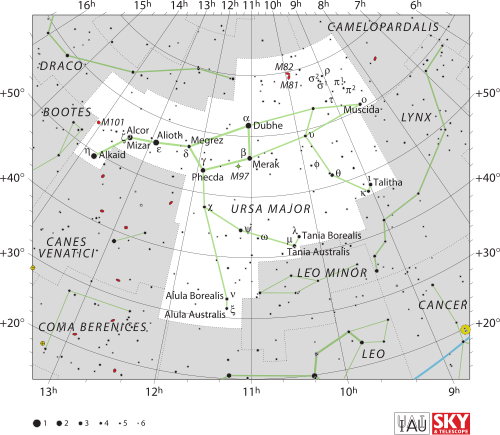 Ursa MajorThe Great Bear and its Big Dipper, the northern sky's most useful signpost.
 CassiopeiaThe Queen's bright W, opposite the Big Dipper, rich in star clusters.
