The Messier objects
Key facts
| Number of objects | 110 |
|---|---|
| Compiled by | Charles Messier, French astronomer, 1758–1781 |
| Original purpose | A list of fuzzy things that are not comets |
| Types included | Galaxies, nebulae, open and globular clusters, a supernova remnant |
| Brightest and easiest | M45 (Pleiades), M42 (Orion Nebula), M31 (Andromeda Galaxy) |
| Equipment needed | Binoculars for about 40 objects; a small telescope for all 110 |
| Best sky | Dark, moonless nights away from city lights |
| Messier marathon | Seeing all 110 in one night, possible around late March |
In short
- Charles Messier listed 110 fuzzy objects so comet hunters would not mistake them for comets.
- The list includes some of the finest sights in the sky: galaxies, nebulae and star clusters.
- Many Messier objects are visible in ordinary binoculars from a dark site.
- Through a small telescope most look like soft gray glows, not the colorful shapes in photos.
- A dark sky, dark-adapted eyes and the trick of averted vision matter more than magnification.
A comet hunter's list
In the 1700s, Charles Messier made his name by discovering comets. The trouble was that the sky is full of faint, fuzzy patches that look a lot like a comet before it grows a tail. To save time, he made a list of these patches so he and others could skip them.
He published the first version in 1774 and expanded it over the next few years. Later astronomers added a handful of objects he had noted, bringing the total to 110. Each one is known by an M and a number, so the Andromeda Galaxy is M31.
The irony is that the list of things Messier wanted to ignore became one of the most popular observing lists ever made. Because he used small telescopes from Paris, almost every object on it is within reach of a modern beginner.
What is in the catalogue
The Messier list is a sampler of the deep sky, the region beyond our Solar System. It contains about 40 galaxies, vast systems of stars millions of light-years away. It also has nebulae, clouds of gas and dust where stars are born or where dying stars have shed their outer layers.
Then there are star clusters. Open clusters are loose groups of young stars, like the Pleiades. Globular clusters are tight balls of hundreds of thousands of very old stars orbiting our galaxy. One object, M1 or the Crab Nebula, is the wreck of a star that exploded in the year 1054.
Nearly all the objects lie north of about 35° south declination, so the list suits observers in the Northern Hemisphere best.
Five favorites for beginners
M45, the Pleiades, is a cluster of young blue stars about 440 light-years away. You can see it with the naked eye in autumn and winter skies as a tiny dipper shape. Binoculars are the perfect tool, showing dozens of stars at once.
M42, the Orion Nebula, sits in the sword of Orion, about 1,300 light-years away. Even binoculars show a misty glow, and a small telescope reveals a bat-shaped cloud with four bright young stars called the Trapezium at its heart.
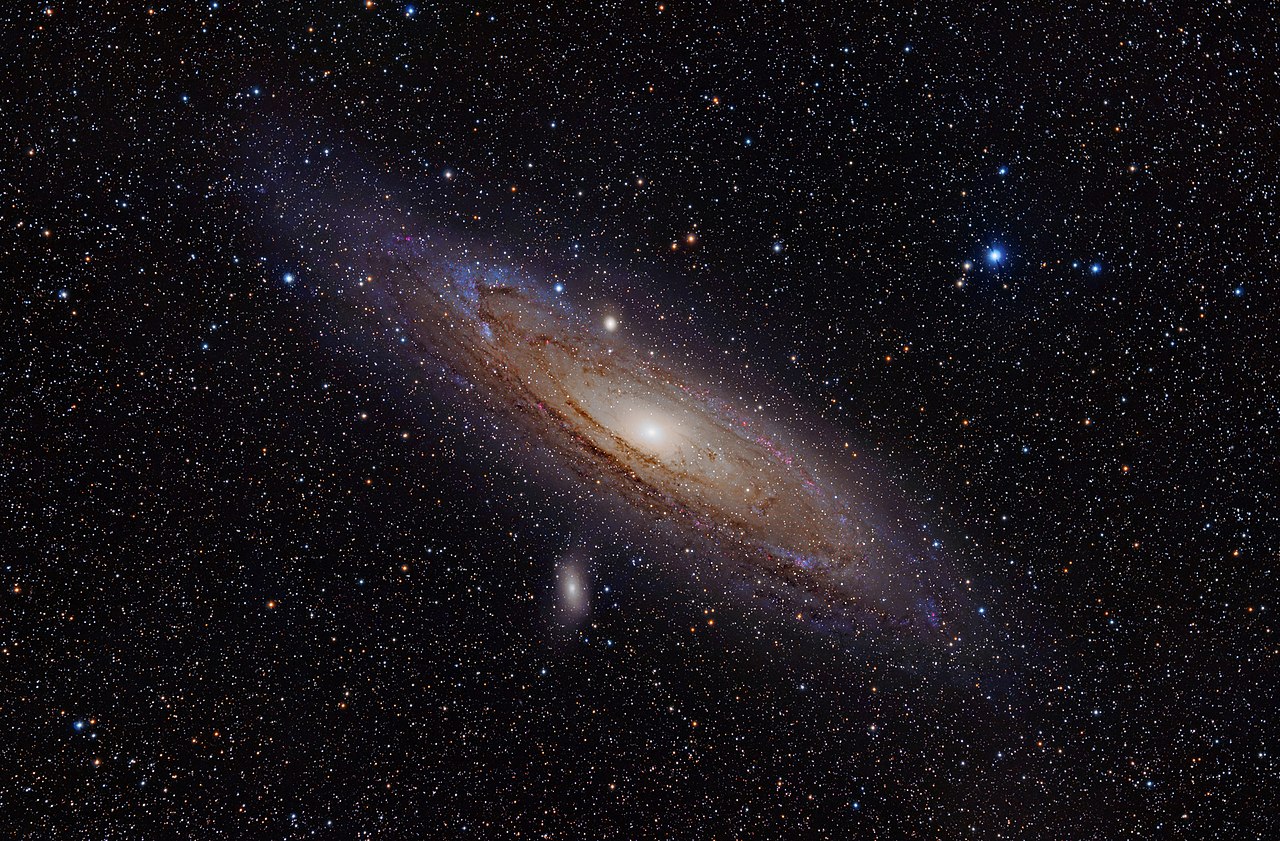
M31, the Andromeda Galaxy, is about 2.5 million light-years away and the most distant thing most people can see without optics. From a dark site it looks like an elongated smudge; binoculars show its bright core fading into a long oval.
M13, the Great Hercules Cluster, is a globular cluster about 22,000 light-years away. In binoculars it is a fuzzy ball; a telescope of about 6 inches or more starts to break its edges into countless pinpoints. M57, the Ring Nebula in Lyra, is the glowing shell of a dying star. It needs a telescope and looks like a small gray smoke ring.
Binoculars versus a small telescope
Binoculars give a wide field and use both eyes, which makes them excellent for large, bright objects such as M45, M44 (the Beehive Cluster) and M31. A pair of about 7x50 or 10x50 shows roughly 40 Messier objects under dark skies.
A small telescope collects more light and allows higher magnification, which helps with compact targets such as M57 and the globular clusters. Galaxies other than the brightest remain faint smudges, and that is normal.
Expect gray, not color. Your eyes cannot see color in dim light, and long-exposure photographs collect light for minutes or hours. Learning to enjoy subtle detail is part of the hobby.
How to find and see them
Start with a star chart or a planetarium app and learn the bright stars near each target. Star-hopping means moving from a bright star you know to fainter ones in small steps until you reach the object. M31, for example, is found by hopping from the corner of the Great Square of Pegasus.
Give your eyes at least 20 to 30 minutes in the dark and use a red light to read charts. Use averted vision: look slightly to the side of a faint object, because the edges of your vision are more sensitive to dim light.
Plan around the Moon. A bright Moon washes out galaxies and nebulae, so the week around new Moon is best. Use a low-power eyepiece first to locate the object, then try more magnification.
Going further
Many observers keep a log and try to see all 110 objects over a year or two. In a short window around late March, the arrangement of the sky makes it possible to see nearly every one in a single night, a challenge called a Messier marathon.
Once you finish, other lists await, such as the Caldwell catalogue, which adds bright objects Messier missed, including many in the southern sky.
 Tripods and telescope mountsAlt-azimuth, Dobsonian, equatorial and GoTo mounts explained, plus binocular tripods.
 Satellites in the night skyHow to spot the ISS, Starlink trains and other satellites, and how they affect astronomy.
 ConstellationsThe 88 official star patterns, the asterisms inside them, and how to start learning them.
